Teramind Employee Monitoring: Features, Benefits and Use Cases
Employee monitoring has changed significantly. Businesses are no longer looking only at how many hours employees spend at their computers. They also want to understand productivity, identify operational bottlenecks, protect sensitive information, and spot risky behavior before it becomes a security incident.
This is where Teramind employee monitoring becomes relevant.
Teramind combines employee activity monitoring with workforce analytics, productivity insights, user behavior analytics, and robust cloud security capabilities. It can help organizations understand how employees use applications and websites, how much time they spend on different activities, and where potential productivity or security issues exist. Teramind also supports use cases such as insider threat detection, compliance management, and data loss prevention.
But employee monitoring should not simply mean watching employees throughout the day. The real value comes from turning activity data into useful information that helps managers, HR teams, operations teams, and security professionals make better decisions.
If you are evaluating options to license or implement these solutions, working with a certified Teramind partner in India ensures your architecture aligns with both technical requirements and localized compliance needs. You can also explore options to buy Teramind in India with structured support and licensing guidance.
What Is Teramind Employee Monitoring?
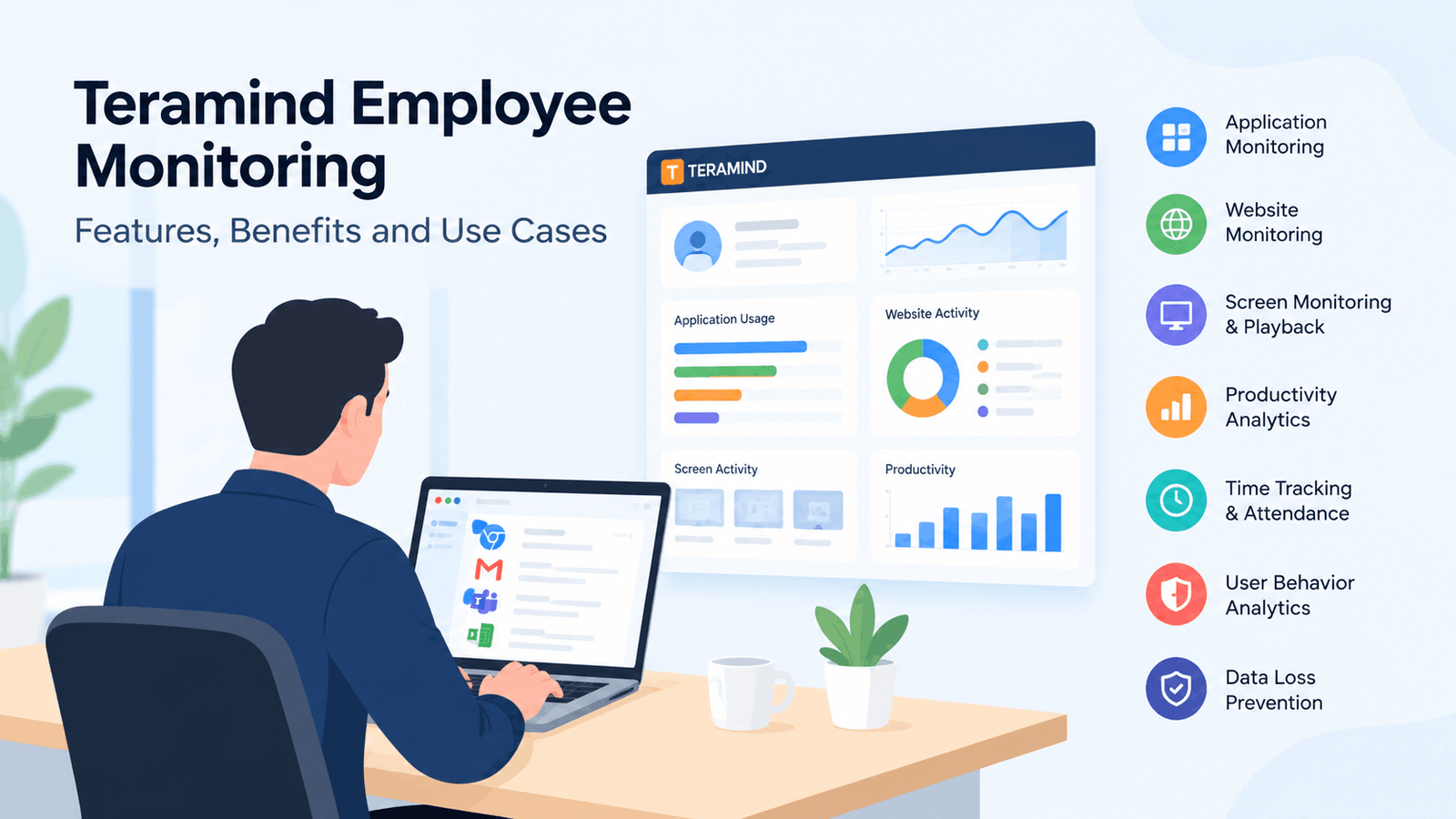
Teramind employee monitoring is designed to give organizations visibility into user activity across company devices. Depending on the configuration and product package, organizations can monitor activities such as application usage, website activity, emails, instant messages, file transfers, screenshots, sessions, and other user actions. Teramind also provides live monitoring and historical playback capabilities.
This information can be used for several distinct purposes:
- An operations manager might use it to understand why a process is taking longer than expected.
- An HR or workforce manager might use productivity analytics to identify workload problems.
- A security team might investigate unusual file transfers or application activity as part of their endpoint security assessment.
- A compliance team might use activity records and audit trails during an internal investigation or regulatory review.
That makes Teramind broader than a simple time-tracking tool.
Key Teramind Employee Monitoring Features
1. Application Monitoring
Employees use multiple applications throughout the working day, and simply knowing that an application is installed does not tell you how it is being used. Teramind can monitor application usage and provide detailed information about time spent in applications and user activity within them. Organizations can use this information to understand software usage, identify inefficient processes, and investigate potentially risky activity.
2. Website Monitoring
Website activity provides another view of workforce productivity and threat exposure. Teramind can track website activity, analyze time spent on websites, and generate reports around internet usage. Organizations can also create policies and alerts for specific types of web activity to strengthen overall email security and web safety controls.
3. Screen Monitoring and Historical Playback
Sometimes activity logs alone do not explain what happened. Teramind supports real-time screen monitoring and historical playback, allowing authorized users to review activity when investigating a productivity issue, policy violation, or security event. This is particularly valuable during an active incident response managed by a dedicated managed SOC service.
4. Productivity Analytics
Employee monitoring becomes more useful when activity data is converted into meaningful productivity information. Teramind’s productivity capabilities help organizations analyze work patterns, active vs. idle time, and resource utilization. This complements modern workplace initiatives where flexibility must be balanced with operational visibility.
5. Time Tracking and Attendance
Manual timesheets make it difficult to evaluate actual project investment. Teramind supports automated time tracking and attendance, helping organizations reduce administrative overhead while keeping accurate records of working hours across remote and on-premise environments.
6. User Behavior Analytics
One of the key differences between basic employee monitoring and advanced security monitoring is the ability to identify anomalous behavior. Teramind’s user activity monitoring capabilities identify risky users, unauthorized actions, and suspicious activities. Automated alerts notify administrators when policies are breached, integrating smoothly into broader threat containment strategies alongside tools like Microsoft Defender for XDR.
7. Data Loss Prevention (DLP)
Employee monitoring plays an essential role in preventing sensitive information from leaving the organization. Teramind supports monitoring and control around activities such as file transfers, cloud uploads, email attachments, and clipboard actions. Combining user-level monitoring with enterprise-grade policies—such as Microsoft Purview Information Protection—creates a complete defense against data leaks.
What Are the Benefits of Teramind Employee Monitoring?
- Better Visibility Into Workforce Activity: Activity data helps identify how applications, websites, and cloud assets are used, uncovering operational inefficiencies that otherwise remain hidden.
- Improved Productivity Analysis: Analytics allow management to distinguish between employee-level performance issues and structural bottlenecks like poorly configured software or unclear workflows.
- Stronger Insider Threat Detection: An employee may accidentally expose sensitive data or a malicious insider might deliberately exfiltrate intellectual property. Monitoring user activity provides early visibility into these threats, supporting robust data security objectives.
- Better Support for Remote Teams: Remote and hybrid work make traditional workplace supervision difficult. Teramind gives leaders full visibility into distributed team activities without needing physical oversight.
- Improved Compliance and Audit Readiness: When an organization must prove compliance during a audit, detailed activity logs are essential. Proper monitoring setup supports frameworks like ISO 27001 when backed by expert ISO 27001 consulting services.
Teramind Employee Monitoring Use Cases
Remote and Outsourced Workforce Management
For organizations with remote workers or third-party contractors, managers need reliable visibility into efficiency and operational integrity. Tracking activities helps maintain accountability while ensuring external users follow core security policies.
Insider Threat Prevention
Security teams leverage user activity intelligence to spot unusual behavior before data leaves the network. Aligning user monitoring with a formal Zero Trust security architecture ensures every access request and user action is verified and evaluated for risk.
AI and Data Governance
As teams increasingly adopt AI tools, tracking how proprietary data enters external tools is crucial. Combining Teramind’s endpoint visibility with comprehensive AI governance and compliance services helps organizations prevent confidential IP from being exposed via uncontrolled AI queries.
Teramind Employee Monitoring for Different Industries
Different industries leverage monitoring to solve specific regulatory and operational challenges:
- Financial Services: Focus on insider threat mitigation, regulatory reporting, data protection, and audit readiness.
- Healthcare Organizations: Focus on protecting patient health information (PHI), auditing database access, and verifying compliance with healthcare data regulations.
- Technology Companies: Focus on protecting source code, sensitive intellectual property, and cloud environment credentials.
- Professional Services & BPOs: Focus on measuring client-billable time, ensuring quality control, and securing sensitive client files across remote workforces.
Is Teramind Just an Employee Surveillance Tool?
Employee monitoring can create friction when implemented purely as surveillance. A structured implementation defines clear business objectives, limits monitoring to necessary systems, and respects user privacy boundaries.
Teramind includes configurable controls that allow administrators to disable monitoring for specific roles, exclude personal web usage, or limit screen capture features. Businesses should treat monitoring as a tool for operational clarity and risk reduction rather than blanket surveillance.
How to Implement Teramind Employee Monitoring Effectively
- Define the Core Objective: Establish whether the primary goal is productivity tracking, compliance auditing, insider threat detection, or data loss prevention.
- Perform Security and Compliance Assessments: Conduct an upfront security assessment to map out where sensitive data lives and which endpoints require monitoring agents.
- Establish Access & Retention Rules: Determine who can review user session logs, how long historical recordings are stored, and what triggers an automated alert.
- Partner with Experienced Specialists: Engaging with an expert cloud advisory and consulting service guarantees that your deployment satisfies both operational demands and technical standards.
Teramind Employee Monitoring: Who Is It For?
Teramind is ideal for organizations that require more than simple time clock apps. It offers significant value to:
- Companies managing distributed, remote, or hybrid teams
- Organizations relying on outsourced or contractor operations
- Financial, healthcare, and technology firms handling sensitive customer data
- Enterprises seeking unified user behavior analytics and endpoint security
- Security Operations Centers (SOC) needing visibility into end-user actions during incident investigations
Final Thoughts
Teramind employee monitoring goes beyond simply recording daily computer tasks. When deployed with clear policy frameworks, it provides deep intelligence into workforce efficiency, operational health, and insider security risks.
To learn more about implementing user activity monitoring, structuring licensing, or integrating Teramind with your existing security stack, explore our managed security options or reach out through our contact page to consult with our architecture team.
Ready to Secure Your Hybrid Workforce with Teramind?
