
How to Choose the Best Microsoft Dynamics 365 Consulting Providers
Choosing a Microsoft Dynamics 365 consulting provider sounds straightforward until you start comparing your options.
One company may have strong CRM expertise. Another may focus on ERP implementations. Some providers are good at migration, while others are better at integration, customization, or ongoing support.
Then there is the biggest question: How do you know whether a provider is actually right for your business?
That matters because Dynamics 365 is rarely just another application added to your IT environment. It can become part of your sales, finance, customer service, operations, reporting, and business processes.
A poor implementation can leave employees frustrated, create unnecessary customization, and make your technology environment harder to manage.
The right consulting partner should do the opposite.
They should understand what your business is trying to achieve, identify where Dynamics 365 can help, and build a solution that works with your existing technology.
Here is a practical way to evaluate the best Microsoft Dynamics 365 consulting providers before signing a contract.
1. Start With the Business Problem, Not the Software
Before speaking to consulting companies, write down why your organization is considering Dynamics 365.
Perhaps your sales team is managing customer information across spreadsheets. Maybe different departments cannot access the same information. Perhaps your existing CRM is difficult to customize, or your finance and operational processes rely heavily on manual work.
These problems should drive your technology decision.
For example, if your organization already relies heavily on Microsoft 365, the consulting provider should understand how your existing Microsoft environment can work alongside your business applications. You can also review your broader Microsoft environment through services such as Microsoft 365 consulting services and Microsoft 365 integration services.
The important question is not simply, “Can you implement Dynamics 365?”
Ask instead:
“How would you use Dynamics 365 to solve our current business problems?”
The quality of the answer tells you much more about a provider than a list of certifications.
Evaluate Your Current Microsoft Setup Before Starting
2. Look for Relevant Dynamics 365 Experience
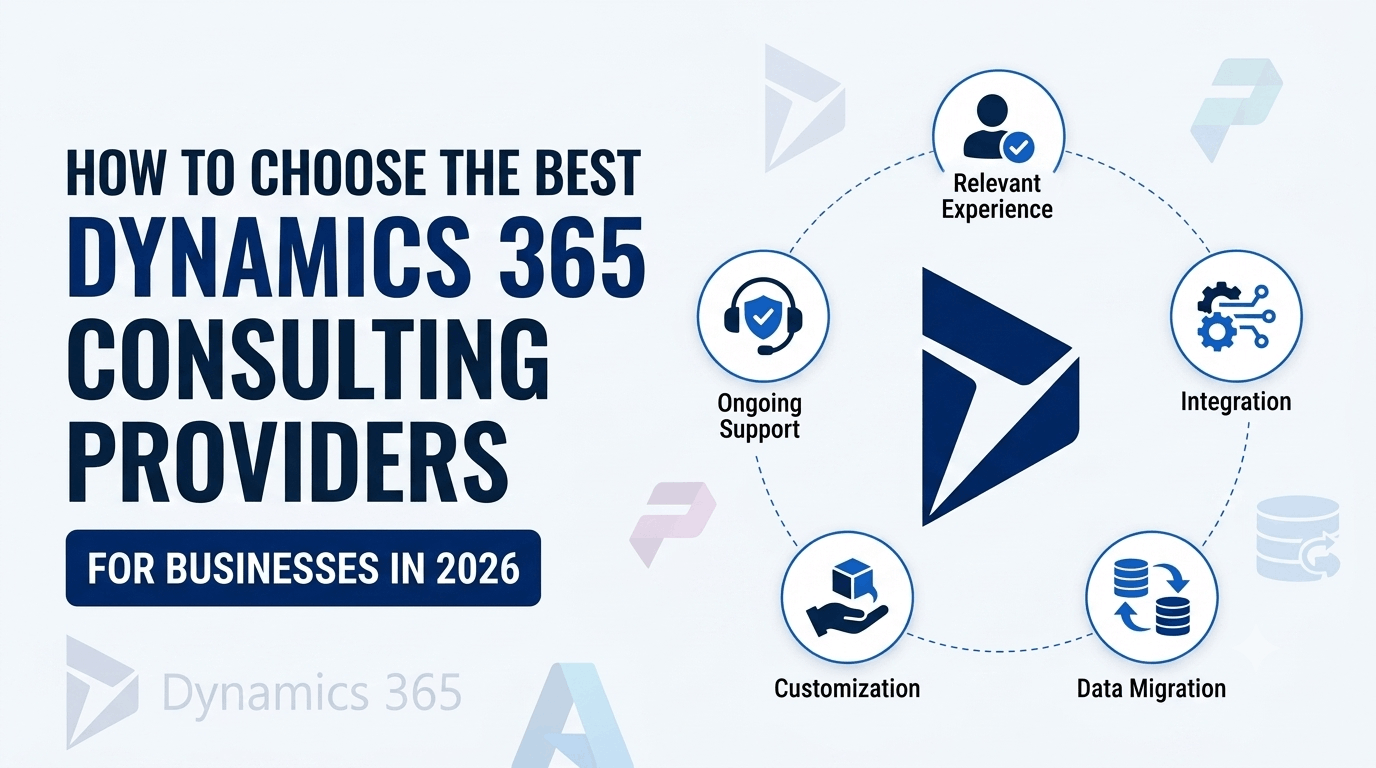
Experience matters, but you need to look beyond the number of projects a provider claims to have completed.
Ask whether they have worked with businesses similar to yours.
If you are implementing Dynamics 365 Sales, ask about previous CRM projects. If you need Dynamics 365 for finance and operations, look for relevant ERP experience. If you are replacing an existing business application, ask specifically about migration projects.
Also ask what their consultants actually handled.
Did they only configure the platform?
Or did they help with business process discovery, data migration, integrations, testing, user training, security, and post implementation support?
This distinction is important because successful Dynamics 365 adoption usually depends on much more than configuration.
3. Test Their Understanding of Your Existing IT Environment
Dynamics 365 will usually need to work with other systems.
Your organization may already use Microsoft 365, Azure, Teams, Power BI, Power Apps, Power Automate, SharePoint, or third party business applications.
That means your consulting provider needs to understand the wider technology environment.
For example, if your organization wants to automate a manual approval process, the answer may involve Dynamics 365 together with Power Automate rather than creating a heavily customized Dynamics solution.
Similarly, if business users need dashboards and management reporting, integration with Microsoft Power BI consulting services may be part of the overall architecture.
Ask potential providers to draw a simple picture of how they would connect Dynamics 365 with your current systems.
If they cannot explain the architecture clearly to your technical and business teams, keep asking questions before moving forward.
4. Pay Close Attention to Data Migration
Data migration is one of the areas where a Dynamics 365 project can become much more complicated than expected.
Your existing CRM or ERP may contain duplicate customers, incomplete records, outdated information, inconsistent formats, and years of historical data.
Moving all of that information into a new platform without proper preparation can create problems after launch.
Ask the consulting provider:
- How will existing data be assessed?
- How will duplicate records be identified?
- How will data be mapped?
- What information actually needs to be migrated?
- How many test migrations will be performed?
- How will the final migration be validated?
If your project also involves Microsoft cloud migration, experience with Azure migration services can be useful when the wider technology environment is moving or being modernized at the same time.
Do not accept “we have done migrations before” as the complete answer.
Ask them to explain how they would approach your data.
5. Ask What They Will Customize and Why
This is one question I would strongly recommend asking every Dynamics 365 provider:
“What would you configure using standard capabilities, and what would you customize?”
There is a reason for asking this.
Businesses sometimes try to reproduce every existing process inside a new system. That can result in unnecessary customization and greater complexity.
An experienced consulting partner should challenge inefficient processes when appropriate.
The objective should not be to recreate your old system inside Dynamics 365.
It should be to improve the way your organization works.
This is also where Power Platform expertise can become valuable. Depending on the requirement, Microsoft Power Apps consulting services or Microsoft Power Automate consulting services may provide a better solution than extensive customization.
6. Do Not Treat Security as an Afterthought
Business applications can contain sensitive customer, financial, employee, and operational information.
Security therefore needs to be considered during solution design.
Ask your prospective provider how they approach identity, permissions, access control, data protection, auditing, integrations, and governance.
This becomes particularly important when Dynamics 365 is connected to Microsoft 365 and Azure.
Your consulting partner should understand how business application security fits into your wider security architecture rather than treating Dynamics 365 as an isolated system.
Organizations with broader Microsoft security requirements may also benefit from reviewing their Microsoft 365 security assessment to identify security and configuration issues across their existing environment.
7. Find Out What Happens After Go Live
A consulting company may impress you during implementation and then become difficult to reach once the project is completed.
That is why post implementation support should be part of your provider evaluation.
Ask:
Who will support us after go live?
Then get specific.
What are the response times? Who handles critical issues? Can the provider make configuration changes? Can they help with future integrations? Will they provide optimization and upgrade support?
Your business will not remain static after implementation.
New employees will join. Processes will change. Microsoft will introduce new capabilities. Your reporting requirements may evolve.
A provider that can support your environment after deployment can therefore be considerably more valuable than a company focused only on completing the initial project.
If you need broader Microsoft environment support, compare this with what is included in Microsoft 365 managed services and determine whether your provider can offer a similar long term support model for your wider technology environment.
8. Compare Proposals Based on Scope, Not Just Price
This is where many buying decisions go wrong.
Suppose Provider A gives you a lower quotation than Provider B.
That does not necessarily mean Provider A is cheaper.
One proposal may include discovery, data migration, integrations, testing, training, documentation, and post implementation support.
The other may cover only configuration and deployment.
Compare the proposals line by line.
Look at implementation scope, migration, integrations, customization, testing, training, documentation, support, timelines, and additional charges.
You are not really comparing two prices.
You are comparing two different levels of implementation risk.
9. Ask for a Realistic Implementation Roadmap
Before choosing a provider, ask them to show you how they expect the project to progress.
A sensible roadmap should explain the major stages from discovery and solution design through configuration, migration, testing, training, deployment, and post implementation support.
Pay attention to what they need from your team.
A provider that asks detailed questions about your users, workflows, data, integrations, security requirements, and business objectives is usually demonstrating a more mature implementation approach.
Be cautious when someone promises an unusually fast deployment without first understanding the complexity of your environment.
Fast is valuable.
Fast without proper planning can become expensive.
10. Choose the Provider That Understands Your Future
There is no single company that is automatically the best Microsoft Dynamics 365 consulting provider for every business.
The right choice depends on your industry, business processes, existing applications, data, integrations, security requirements, budget, and future plans.
Before making your final decision, ask yourself five questions:
- Does this provider understand the business problem we are trying to solve?
- Can they demonstrate relevant Dynamics 365 implementation experience?
- Can they handle our data migration and integrations?
- Do they understand security and governance?
- Will they still be useful after the system goes live?
If the answer is yes, you are looking at a much stronger candidate.
The Best Provider Is the One That Reduces Your Risk
The best Microsoft Dynamics 365 providers do more than configure a Microsoft platform.
They help you make better technology decisions.
They question unnecessary customization. They understand your existing systems. They prepare your data properly. They consider security before implementation. They plan for adoption and support after they go live.
That is ultimately what you should look for when comparing providers.
Do not choose the company that simply promises to implement Dynamics 365. Choose the partner that can explain how the implementation will improve your business and how they will help you maintain that value over time.
Ready to Find the Right Dynamics 365 Implementation Partner?
