
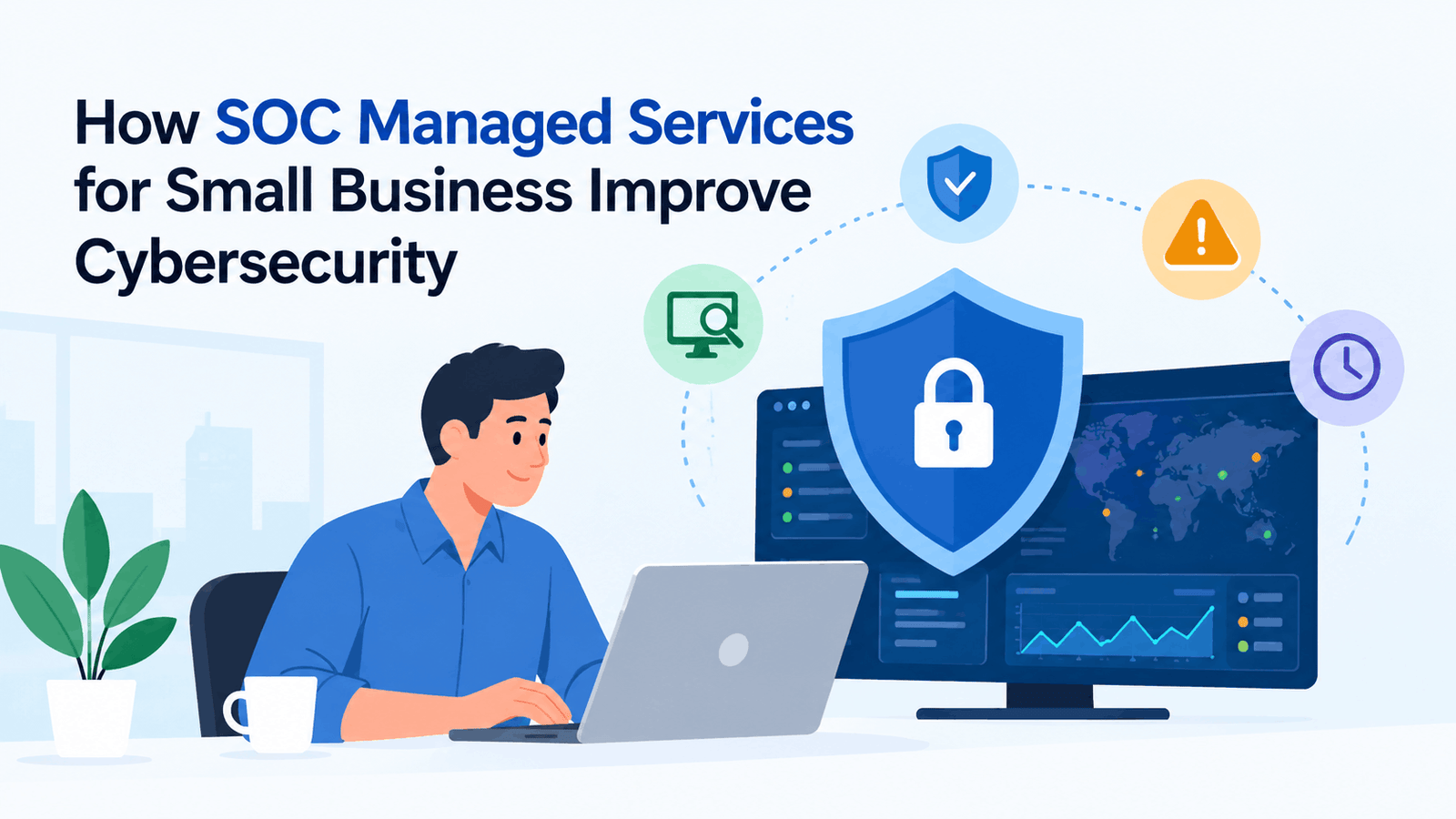
How SOC Managed Services for Small Business Improve Cybersecurity
A small business does not need thousands of employees to have a serious cybersecurity problem.
Imagine this situation. Your team has Microsoft 365, employees working from different locations, laptops connecting to business applications, and several cloud services handling important information. Your IT team has antivirus, MFA, firewalls, and other security controls in place.
Everything looks reasonably secure.
Then an employee clicks a convincing phishing link at 11:40 PM.
The attacker obtains the user’s credentials, signs into Microsoft 365, and starts looking for sensitive information. There is a security alert, but nobody from the IT team is watching the environment at that time.
The problem is not necessarily that the business lacked security technology. The problem is that nobody was available to investigate what the technology was reporting.
This is one of the situations where SOC managed services for small business can provide real value.
The Problem Is Often Not Detection. It Is Knowing What Matters.
Most businesses already receive security alerts.
Microsoft Defender might report suspicious activity. An endpoint security platform may flag unusual behavior. Microsoft Entra ID may record an unusual sign in. Email security may detect a suspicious message.
But alerts are not the same as security decisions.
A small IT team can easily end up with dozens of notifications competing for attention. Some are harmless. Some need investigation. A few could indicate an active attack.
This is where a managed Security Operations Center changes the equation.
Instead of expecting your internal IT administrator to manually inspect every alert, security analysts can monitor events, investigate suspicious activity, correlate information from different systems, and determine whether something requires action.
That human investigation is often more valuable than simply adding another security product.
What Happens When Your IT Team Cannot Watch Security 24/7?
This is a practical question every small business should ask.
- If your IT administrator finishes work at 6 PM, what happens to security events at 9 PM?
- If an employee’s account is compromised overnight, who notices?
- If ransomware begins spreading across endpoints on a weekend, who investigates the first warning?
You may have excellent security controls, but their effectiveness is reduced when nobody is available to respond.
A managed SOC provides continuous security monitoring so that suspicious activity does not have to wait for the next working day.
This does not mean every alert triggers a phone call. Good security operations are about prioritization.
The objective is to identify activity that could represent genuine risk and escalate it appropriately.
A Realistic Example: One Compromised Account
Consider a small professional services company with 70 employees.
An employee receives an email that appears to come from a supplier. They enter their Microsoft 365 credentials into a fake sign in page.
The attacker now has valid credentials.
Initially, there may be nothing obviously malicious about the account. The attacker may simply sign in and observe the environment.
Later, the account signs in from an unusual location. The attacker accesses SharePoint files. Several mailbox rules are created. More authentication attempts occur.
If these events are examined separately, some may look relatively harmless.
When correlated, however, they tell a much clearer story.
This is the type of investigation a security operations team can perform. The value comes from connecting the dots rather than waiting for one dramatic alert.
Where Microsoft Sentinel Can Fit
For businesses already invested in Microsoft technologies, the security monitoring architecture deserves particular attention.
Microsoft Sentinel can collect security information from different sources and support detection, investigation, and response workflows.
But implementing a SIEM does not automatically create a SOC.
This is an important distinction.
You can deploy Sentinel, connect your data sources, and configure detection rules. You still need people who understand what the alerts mean, investigate unusual activity, tune detections, and determine when an incident needs escalation.
Technology provides visibility.
Security expertise turns that visibility into action.
Small Businesses Also Need Endpoint Visibility
Endpoints are another area where businesses can miss the bigger picture.
A laptop might show unusual PowerShell activity. Another device may suddenly communicate with a suspicious destination. An employee account may behave differently immediately before the endpoint event occurs.
Looking at each event independently makes investigation harder.
A security operations team can correlate endpoint activity with identity, email, cloud, and network signals.
This becomes especially important as remote work increases the number of devices and locations connecting to business systems.
Businesses that need to strengthen this layer can also consider endpoint security services as part of a broader security strategy.
Do You Actually Need a SOC?
Not every small business needs a sophisticated 24 hour security operation.
This is where I would recommend looking at the business rather than simply following a security checklist.
Ask yourself:
- How dependent are you on cloud applications?
- How sensitive is your customer or financial data?
- How many employees have access to important systems?
- Would a compromised Microsoft 365 account cause serious disruption?
- Does your internal IT team have the time and expertise to investigate security incidents?
- What happens if an attack begins outside business hours?
If the answers indicate meaningful exposure but there is no internal security team available to monitor and investigate events, outsourcing security operations can make practical sense.
Managed SOC Is Not a Replacement for Basic Security
There is another misconception worth addressing.
A managed SOC cannot compensate for fundamentally poor security controls.
If MFA is not properly configured, administrator accounts are unnecessarily exposed, devices are unmanaged, or critical systems are not patched, monitoring alone will not solve the underlying problems.
Security monitoring works best when it sits on top of sensible security foundations.
For example, a business may first identify weaknesses through a cloud security assessment or security review and then use continuous monitoring to detect suspicious activity after those controls are improved.
Think of it this way.
- Security controls help prevent and limit attacks.
- Security monitoring helps you recognize when something is getting through.
- Incident response helps you contain the damage.
You need all 3 working together.
What Should a Small Business Expect From a Managed SOC?
Do not judge a provider simply by asking how many security tools they use.
Ask what happens after an alert appears.
- Who investigates it?
- How is severity determined?
- How quickly is the customer informed?
- What happens if an endpoint is compromised?
- Can the team investigate Microsoft 365 and identity related incidents?
- How are false positives handled?
- What reporting will the business receive?
These questions reveal much more about the quality of a SOC service than a list of technologies.
A good provider should help reduce the burden on your internal IT team rather than simply giving them another dashboard to monitor.
The Real Business Value
The strongest reason for using SOC managed services for small business is not that it sounds more advanced than traditional security.
It is operational.
Your IT team should not have to choose between fixing an employee’s laptop, managing cloud infrastructure, supporting users, and investigating a suspicious authentication event at the same time.
Security operations require attention and context.
For a growing business, having specialists continuously watching for meaningful threats can provide something that security software alone cannot provide: someone is paying attention when your team cannot.
That is ultimately what a managed SOC should deliver. Not more alerts, but better visibility, faster investigation, and a clearer path from suspicious activity to appropriate action.
