

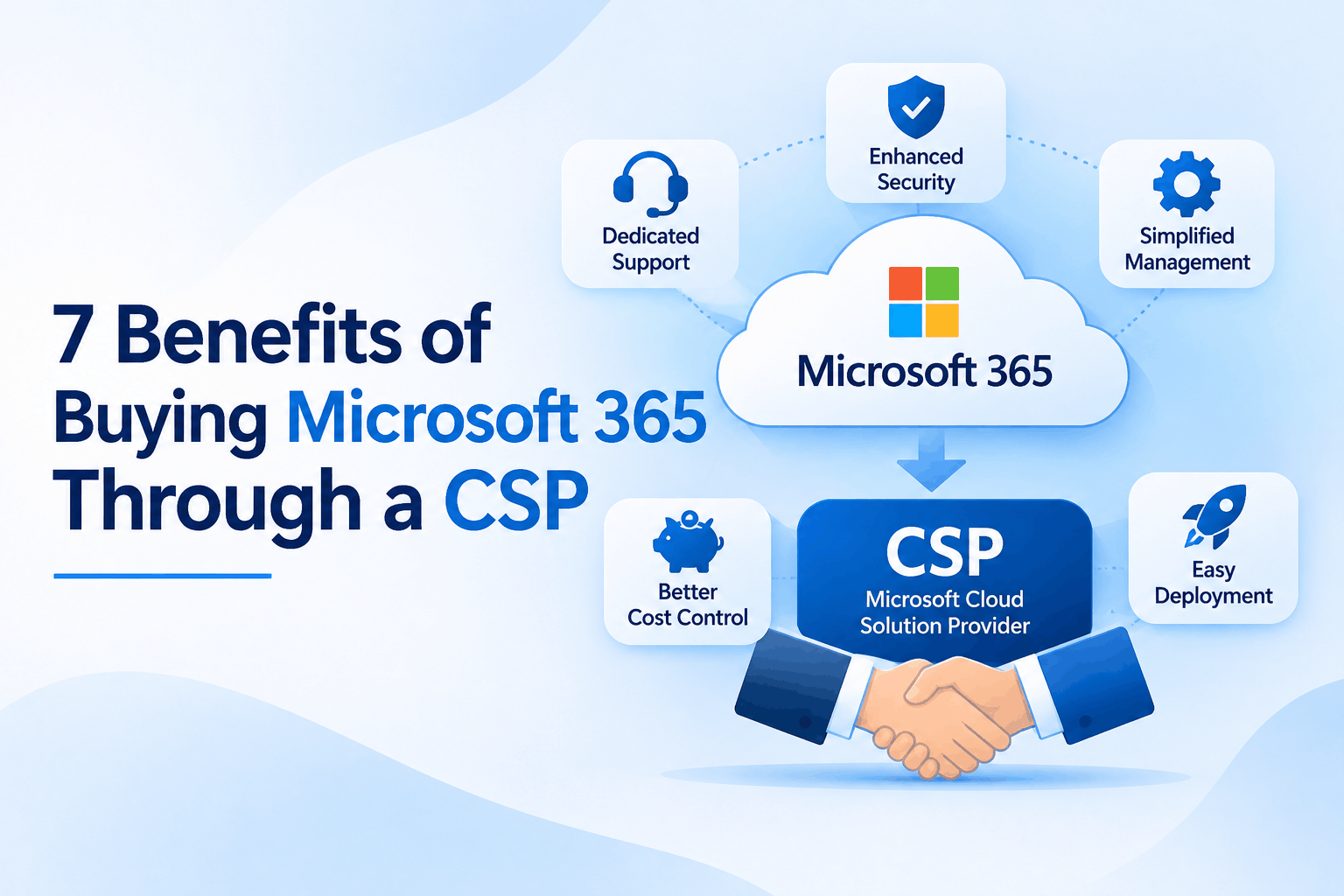
7 Benefits of buying Microsoft 365 through a CSP
Choosing the right Microsoft 365 subscription is only part of the decision. How you purchase, manage, and support those licenses can have an equally significant impact on your IT operations. For businesses managing multiple employees, remote teams, or growing cloud environments, purchasing licenses directly from Microsoft is not always the most convenient approach.
This is where a Microsoft Cloud Solution Provider (CSP) comes into the picture.
A CSP is an authorized Microsoft partner that can sell Microsoft 365 subscriptions and provide additional services such as license management, deployment assistance, technical support, and ongoing administration. Instead of managing every licensing and support requirement independently, businesses can work with one partner who understands their Microsoft environment.
But is purchasing through a CSP actually better? Let’s explore seven practical benefits and where they make a difference in day-to-day business operations.
1. Get Licensing Advice Based on Actual Business Requirements
One common licensing mistake is purchasing the same Microsoft 365 plan for everyone, regardless of their responsibilities.
For example, your finance team may need desktop versions of Excel and advanced collaboration features, while frontline employees might only require web-based applications, email, and Teams access. Giving everyone the same subscription could mean paying for features that some employees never use.
A CSP partner can review your workforce requirements and recommend suitable Microsoft 365 business or enterprise plans.
This becomes particularly useful when:
- Different departments require different applications.
- Some employees need desktop Office applications while others work through browsers.
- Your organization is expanding and adding new users regularly.
- You need to evaluate security and compliance features before selecting a plan.
Practical value: Rather than simply counting licenses, you can build a licensing structure around how employees actually work. This helps reduce unnecessary subscriptions without compromising essential functionality.
2. More Convenient License Management as Your Business Grows
Managing licenses becomes increasingly complicated as an organization expands. Employees join, leave, change departments, and require different access permissions.
Without a structured process, businesses can end up paying for unused licenses or delaying access for new employees.
Through a CSP relationship, your partner can help manage subscription-related changes, including:
- Adding licenses when new employees join.
- Reviewing license allocation across departments.
- Identifying unused or underutilized subscriptions.
- Supporting subscription changes and renewals.
- Helping align licensing with changing business requirements.
Consider a company that grows from 40 to 85 employees within six months. Its original licensing arrangement may no longer be appropriate. A CSP partner can help review the subscription structure and plan for additional capacity.
For organizations with more complex environments, this can also complement Microsoft 365 tenant management, where licensing, users, and administrative settings need to remain properly organized.
3. Access to a Dedicated Support Partner
When Microsoft 365 stops working as expected, the problem is rarely limited to one application.
An employee might be unable to access Outlook, Teams meetings could experience connectivity issues, or SharePoint permissions might prevent an entire department from accessing important documents.
Businesses without dedicated IT resources may struggle to identify whether the issue involves licensing, user configuration, identity management, or the underlying service.
One of the key benefits of buying Microsoft 365 through a CSP is having a partner who can provide an additional support channel.
Depending on the services included in your agreement, the partner may assist with:
- Subscription and billing queries.
- User and license-related issues.
- Microsoft 365 configuration problems.
- Troubleshooting and escalation of technical issues.
- Guidance on product features and administration.
However, support coverage varies between providers. Before signing an agreement, clarify response times, support hours, escalation procedures, and whether ongoing technical assistance is included or separately charged.
Practical value: Your internal IT team gets an additional resource instead of having to investigate every Microsoft 365 issue independently.
4. Better Visibility and Control Over Licensing Costs
The lowest license price does not necessarily translate into the lowest overall Microsoft 365 cost.
Consider an organization with 100 employees. Some users may have licenses they no longer need, while others may be using basic subscriptions despite requiring additional security or collaboration capabilities.
These gaps can create unnecessary spending or operational risks.
A CSP partner can help review subscription usage, identify licensing overlaps, and recommend adjustments based on actual requirements.
Businesses can also discuss available billing arrangements and subscription terms with their provider. Depending on the offer, licensing may be available with different commitment periods and billing frequencies.
However, it is important to understand that monthly billing does not always mean monthly cancellation flexibility. Annual commitments paid monthly can still carry contractual obligations.
Before purchasing, ask for a clear breakdown of:
- Per-user subscription costs.
- Applicable taxes and additional charges.
- Monthly versus annual commitment terms.
- Renewal dates and cancellation conditions.
- Charges for additional services.
Practical value: You gain a clearer picture of what your organization is paying for and where licensing expenses can be optimized.
5. Support for Microsoft 365 Security and Compliance
Purchasing Microsoft 365 licenses does not automatically mean your organization is securely configured.
Features such as multi-factor authentication, conditional access, data loss prevention, and information protection require appropriate configuration, policies, and ongoing administration.
This is particularly important for businesses handling financial information, employee records, healthcare data, or confidential customer information.
An experienced CSP partner with security capabilities can help identify the right Microsoft 365 licensing options and support their implementation.
For example:
- Microsoft Entra Conditional Access can help control access based on defined conditions.
- Microsoft Defender can strengthen threat detection and protection.
- Microsoft Purview can support data classification, information protection, and governance.
The availability of these capabilities depends on the selected subscription and licensing requirements.
Organizations can explore Microsoft 365 security best practices and consider a Microsoft 365 Security Assessment to identify configuration gaps.
Practical value: Instead of treating licensing and cybersecurity as separate decisions, businesses can plan them together and make better use of the security capabilities available in their subscriptions.
6. Easier Microsoft 365 Deployment and Migration
Purchasing licenses is straightforward. Deploying Microsoft 365 correctly across an organization can be considerably more challenging.
A business migrating from an older email platform, moving files to SharePoint, or introducing Microsoft Teams needs to consider user access, data migration, permissions, security policies, and employee adoption.
A CSP partner that also provides implementation services can help coordinate these activities.
Depending on the project scope, assistance may include:
- Microsoft 365 tenant configuration.
- Exchange Online and email migration.
- SharePoint and OneDrive deployment.
- Microsoft Teams configuration.
- Identity and access management.
- User onboarding and administrative guidance.
For example, a company moving from an existing email platform to Exchange Online needs more than user licenses. It must plan mailbox migration, DNS changes, email flow, authentication, and post-migration testing.
Explore Microsoft 365 deployment services and Microsoft 365 data migration to understand how these activities can be managed.
Practical value: Your organization can approach Microsoft 365 adoption as a planned IT project rather than simply activating subscriptions and leaving employees to figure everything out.
7. One Partner for Licensing and Ongoing Cloud Management
Perhaps the most valuable advantage of a CSP relationship is the opportunity to consolidate multiple Microsoft 365 requirements under one service provider.
Without a structured partnership, businesses may purchase licenses from one source, hire another company for deployment, and depend on internal employees for ongoing administration.
This can create communication gaps and make accountability difficult when issues arise.
A capable CSP partner may offer a broader combination of services, including licensing, tenant administration, security configuration, technical support, and managed services.
As your organization grows, these services can evolve alongside your requirements.
For example, a business initially purchasing Microsoft 365 Business subscriptions may later need enterprise-level identity management, advanced threat protection, compliance controls, or centralized device management.
Working with a partner that understands your existing environment can make these transitions easier to plan.
You can also explore Microsoft 365 managed services for ongoing administration, optimization, and operational support.
Practical value: Instead of managing multiple disconnected technology relationships, you have an opportunity to work with one partner who understands your Microsoft cloud environment.
What Should You Check Before Choosing a Microsoft CSP?
Not every CSP offers the same level of expertise or support. Some primarily sell licenses, while others provide deployment, security consulting, and ongoing managed services.
Before selecting a provider, ask these questions:
- Microsoft authorization: Can the provider establish a legitimate CSP relationship and supply the required subscription details?
- Licensing expertise: Can they explain the differences between Microsoft 365 plans and recommend suitable options?
- Technical support: What support is included, and what are the response times?
- Security capabilities: Can they help configure identity, endpoint, and data protection controls?
- Billing transparency: Are commitment periods, renewal conditions, taxes, and additional charges clearly documented?
- Implementation experience: Can they assist with deployment, migration, and ongoing administration?
A lower quotation should not be the only deciding factor. The provider’s technical capabilities and ability to support your business after the purchase matter just as much.
Final Thoughts
Buying Microsoft 365 through a CSP is not simply another way to purchase software licenses. It creates an opportunity to combine subscription management with technical expertise, deployment assistance, security guidance, and ongoing support.
The benefits of buying Microsoft 365 through a CSP become particularly valuable when your organization has multiple departments, growing licensing requirements, limited internal IT resources, or security and compliance responsibilities.
The key is to choose a partner that offers more than license reselling.
At NG Cloud Security, we help businesses navigate Microsoft cloud licensing, deployment, security, and ongoing management. Whether you are planning a new Microsoft 365 implementation or reviewing an existing environment, our team can help you identify the right approach.
Ready to make better decisions about your Microsoft 365 environment?
