

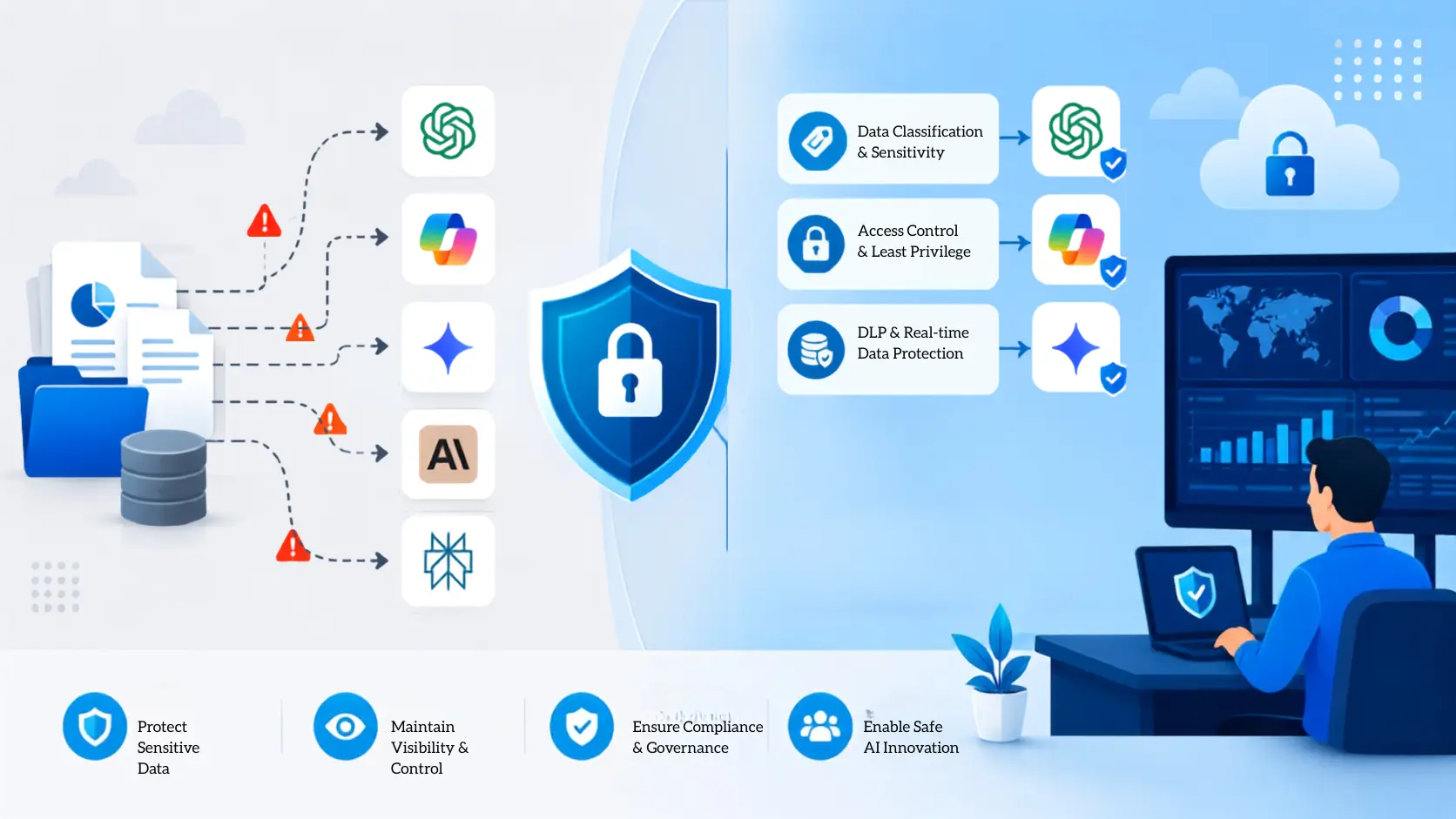
How to Protect Sensitive Business Data in the AI Era
AI data security solutions are the most urgent security investment businesses need to make in 2026 — and most organizations are behind.
Sensitive data makes up 34% of everything employees input into AI tools like ChatGPT, up from eleven percent in 2023. Ninety percent of organizations encountered risky AI prompts in 2025. Twenty percent of global businesses reported a data breach caused by shadow AI in the past year, according to IBM research. And the July 2026 Microsoft Security Blog confirmed that Microsoft Purview now integrates with Microsoft Entra Internet Access to extend data security to the network layer — blocking sensitive data from reaching unmanaged AI apps in real time.
The pattern across every piece of recent research is consistent. AI adoption is accelerating. Data governance is lagging behind. And the gap between those two speeds is exactly where breaches are happening.
This guide explains why the traditional approach to data security no longer works in AI-powered environments, what the most dangerous risks look like in practice, and how to implement ai data security solutions that actually close the gap.
Why AI Has Made Data Security Harder for Every Business
Traditional data security was built around a predictable model. Employees created files, stored them in known locations, and shared them through IT-managed channels. Security teams could monitor those flows and enforce policies at defined control points.
AI breaks all of it. AI models, copilots, and automated agents now generate, reshape, and distribute sensitive information across clouds, SaaS platforms, and endpoints faster than any security team can manually track. The 2026 Microsoft Data Security Index found that poor integration, lack of unified visibility, and fragmented dashboards are the top challenges organizations face when trying to govern AI-powered data flows.
Every AI tool an employee uses is a potential data exit point that existing security controls were not designed to cover. Without purpose-built ai data security solutions, businesses are running AI-powered operations with security tools designed for a pre-AI world.
The Most Dangerous AI Data Risks Businesses Face in 2026
Understanding what you are defending against is the starting point for any effective ai data security solutions program. Three risks dominate the current threat picture.
- Shadow AI data exposure: Seventy-seven percent of IT leaders discovered AI-powered applications operating without IT awareness in 2025, according to Zylo research. When employees use unapproved AI tools through personal accounts, businesses lose complete visibility over what data was shared, with which AI provider, under which terms. IT cannot audit it, retrieve it, or protect it after the fact.
- Sensitive data in AI prompts: Employees paste contracts, source code, patient records, and financial data into AI prompts without recognizing the risk. The 2026 Check Point Cybersecurity Report found that risky prompts nearly doubled in 2025 (checkpoint.com/cyber-hub). Even when an AI tool is approved, organizations still need controls over what data can move into it and under what conditions. Approval is not the same as governance.
- Overpermissioned AI agents: AI agents that have access to more data than their workflows require turn a single compromise into a tenant-wide exposure event. Every permission beyond the minimum is potential blast radius. This is why Microsoft’s RSAC 2026 announcements specifically extended Zero Trust architecture to cover the full AI lifecycle — from data ingestion and model training to deployed agent behavior.
AI Data Security Solutions: 6 Critical Steps
These are the six ai data security solutions that Microsoft specialists and enterprise security teams are implementing in 2026 to protect sensitive business data in AI-powered environments.
Step 1: Classify sensitive data before AI can access it.
Sensitivity labels in Microsoft Purview classify documents, emails, and data as Confidential or Highly Confidential and enforce protection rules that travel with the content wherever it goes. This is the foundational control. AI cannot protect data it has not been told is sensitive, and DLP policies cannot enforce boundaries that classification has not established first.
Step 2: Deploy DLP policies that cover AI-specific channels.
Standard DLP policies were designed for email and file sharing. AI era DLP must cover additional channels: Copilot prompts, browser-based AI tool interactions, endpoint copy-paste actions, and API connections. Microsoft Purview now integrates with Microsoft Entra Internet Access to block sensitive data from reaching unmanaged AI apps at the network layer — a capability that reached general availability in July 2026 and works across Microsoft and non-Microsoft browsers.
Step 3: Discover and govern shadow AI before it discovers your data.
The Microsoft Purview AI Hub identifies when employees use unauthorized generative AI tools and attempts to share sensitive data with them. The Purview Browser Extension monitors risky browser activity — visiting unapproved AI sites, uploading sensitive files — and triggers policy responses without continuous surveillance of normal browsing. For Microsoft 365 businesses, these tools provide the shadow AI visibility that was not available even twelve months ago.

Step 4: Apply Zero Trust principles to every AI agent and tool.
Zero Trust means no AI tool or agent is trusted by default — not even Microsoft-built ones. Every agent must authenticate with its own identity through Microsoft Entra Agent ID. Access must be scoped to the minimum the workflow requires. High-impact actions such as external file sharing, email sends to new recipients, and data exports must require human approval before execution. The RSAC 2026 Microsoft Security Blog confirmed that Zero Trust for AI now extends across the full AI lifecycle with a new reference architecture and assessment tool.
Step 5: Monitor AI interactions with audit logging and behavioral detection.
Microsoft Purview audit logging captures Copilot prompt and response content for compliance review and insider threat investigation. Microsoft Defender for Cloud Apps and Defender for Endpoint detect behavioral anomalies from AI tools — unusual data access volumes, unexpected external connections, and access to data outside the agent’s normal scope. Logs that do not exist cannot support an investigation. Enable audit logging before AI tools go into production, not after an incident has occurred.
Step 6: Add managed SOC oversight for AI-related threat detection.
AI threats move faster than manual monitoring can track. A managed Security Operations Center that monitors your Microsoft 365 environment continuously detects threats that automated tools surface but that require human judgment to assess and respond to correctly. Managed SOC services provide the expert oversight layer that makes every other ai data security solution more effective — closing the gap between detection and response at a speed no internal team operating business hours alone can match.
Is Your Business Data Protected in the AI Era?
NG Cloud Security helps businesses implement AI data security solutions across Microsoft Purview, Conditional Access, shadow AI governance, and managed SOC monitoring — tailored to your environment.
What Microsoft Has Built for AI Data Security in 2026
The pace of Microsoft’s ai data security solutions development in 2026 has been significant. The July 2026 Microsoft Security Blog confirmed several capabilities that are now generally available or in preview and that directly address the risks covered in this guide.
- Microsoft Purview DLP now integrates with Microsoft Entra Internet Access to block sensitive data shared with unmanaged cloud and AI apps over the network — working across Microsoft Edge, non-Microsoft browsers, APIs, and add-ins.
- A new DLP policy for Microsoft 365 Copilot email protection is in preview, giving security teams control over how Copilot leverages email content from external sources that may introduce sensitive or unvetted data into AI-generated responses.
- Microsoft Purview Information Protection now enforces sensitivity label restrictions in Outlook on the web when accessed through Microsoft Edge for Business — closing a previous gap where protected emails could be copied, printed, or screenshotted in the browser without restriction.
- The unified DSPM for AI capability in Microsoft Purview provides continuous discovery, classification, and protection of sensitive data across cloud, SaaS, and on-premises assets — operationalizing the principle that AI data security requires continuous oversight, not periodic reviews.
For the full picture of what is available today, the Microsoft Purview data security page at microsoft.com/security/business/data-security provides current capability documentation. For Microsoft 365 businesses, the key principle from the 2026 Data Security Index remains the same: unify data security controls, increase generative AI oversight, and use AI-assisted tools to improve security effectiveness rather than simply accepting AI risk as unavoidable.
How NG Cloud Security Helps Businesses Secure Data in the AI Era
NG Cloud Security provides ai data security solutions for businesses running Microsoft 365, Azure, and hybrid environments. We implement the controls that protect sensitive business data in AI-powered workflows — sensitivity labels, DLP policies for AI channels, shadow AI discovery through Purview AI Hub, Conditional Access for AI-enabled accounts, audit logging, and continuous managed SOC monitoring.
For businesses preparing to deploy Microsoft 365 Copilot, we conduct a data governance readiness assessment that identifies overshared content, misconfigured permissions, and missing sensitivity labels before AI tools begin surfacing data that should not be accessible. For businesses already running AI tools without full governance, we implement the missing controls without disrupting existing workflows.
Our approach to AI data security is built around Microsoft’s own security stack — which means the controls we implement work natively across your Microsoft 365 environment without introducing additional tooling complexity. Learn more about our Microsoft 365 security services at ngcloudsecurity.com/services.
Frequently Asked Questions
What are AI data security solutions and why do businesses need them now?
AI data security solutions are the combination of tools, policies, and processes that protect sensitive business data in environments where AI tools are actively generating, processing, and distributing information. Businesses need them now because traditional data security was designed for predictable data flows through managed channels. AI changes both the speed and the unpredictability of how sensitive data moves — through prompts, AI agents, shadow AI tools, and automated workflows that existing controls were not designed to govern. Without ai data security solutions in place, businesses are running AI-powered operations with pre-AI security tools, and the resulting gap is where most current AI-related breaches occur.
What is shadow AI and how do I stop it from exposing sensitive data?
Shadow AI refers to employees using AI tools that IT has not approved — personal ChatGPT accounts, consumer generative AI services, or AI features embedded in SaaS applications the organization has not reviewed. When employees use these tools for work tasks, businesses lose all visibility over what data was shared, with which provider, and under what terms. The practical defense combines three elements: Microsoft Purview AI Hub to discover which unauthorized AI tools employees are using, DLP policies that block sensitive content from being pasted or uploaded to unapproved AI applications, and an approved AI tools list that gives employees governed alternatives that meet their productivity needs. The goal is not to block AI use — it is to ensure that data moving through AI tools is subject to the same protection policies that govern any other data channel.
How does Microsoft Purview protect sensitive data in AI workflows?
Microsoft Purview protects sensitive data in AI workflows through several integrated controls. Sensitivity labels classify documents and emails and prevent Copilot from surfacing content labeled Highly Confidential to users without appropriate access. DLP policies target AI-specific channels including Copilot prompts, browser-based AI tool interactions, and network-level data transfers to unmanaged AI apps through the Purview integration with Microsoft Entra Internet Access. The Purview Browser Extension monitors risky browser activity including uploads to unauthorized AI sites and triggers policy responses without continuous surveillance. Purview audit logging captures Copilot prompt and response content for compliance review. Together these controls create a layered protection model that governs what data AI can access, what it can include in responses, and what can be shared externally through AI-powered workflows.
Final Thoughts
The AI era has not made data security optional. It has made the cost of inadequate data security immediate and measurable in ways that were easier to defer in a pre-AI world.
Sensitive data is moving through AI systems at a scale and speed that legacy security controls cannot track. The ai data security solutions that close this gap are available today in Microsoft 365. What most businesses need is the implementation expertise and ongoing oversight to deploy them correctly before an incident makes the gap visible.
The businesses that protect their data most effectively in the AI era are not those that restrict AI adoption. They are those that govern it — with classification, DLP, Zero Trust, audit logging, and continuous monitoring working together as a unified protection layer.
Ready to Protect Your Business Data in the AI Era?
Talk to our cybersecurity specialists about AI data security solutions, Microsoft Purview implementation, shadow AI governance, and managed SOC services tailored to your business.
