
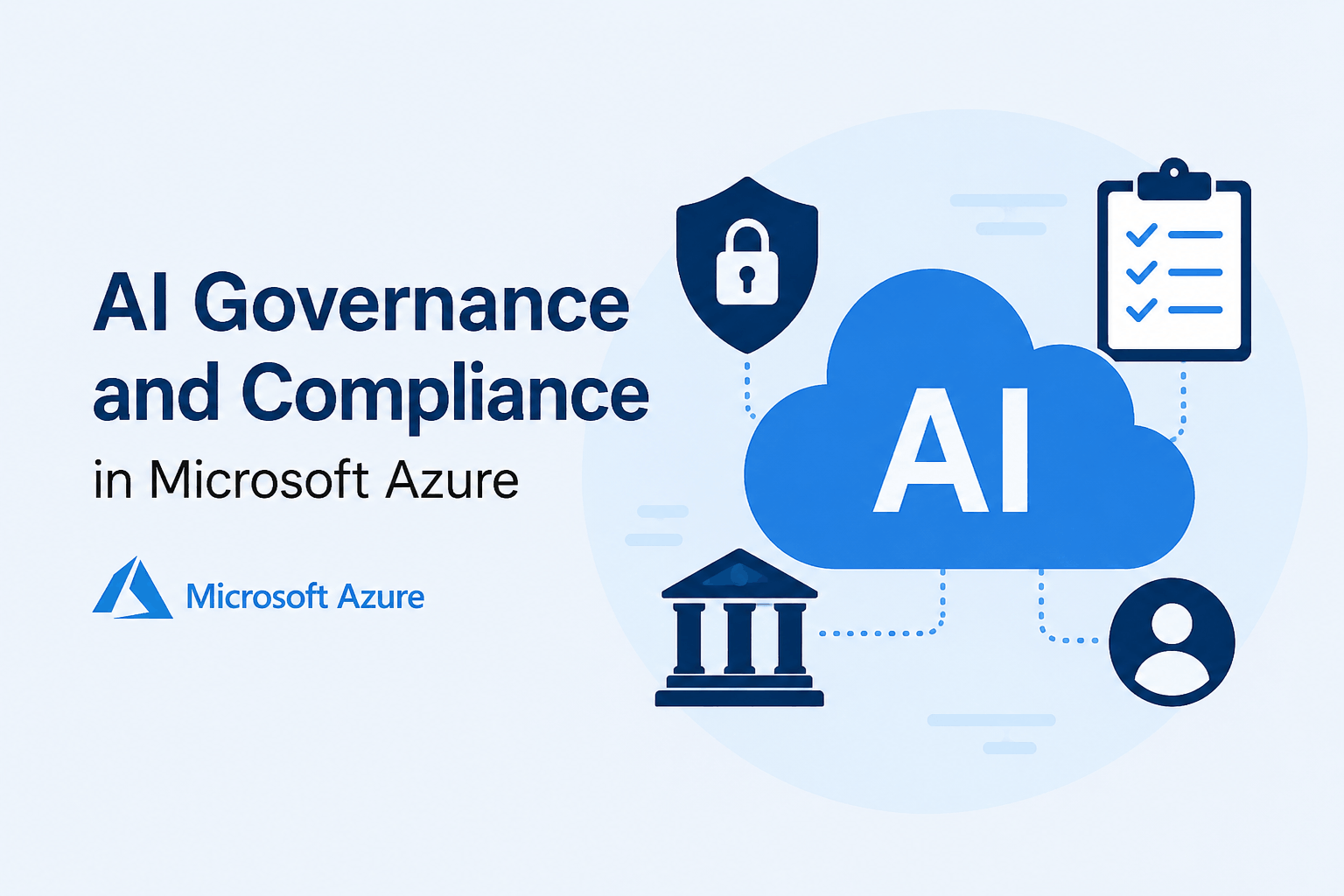
How Organizations Can Govern and Secure AI Using Microsoft’s Cloud Adoption Framework
Artificial Intelligence is rapidly transforming how organizations operate. From Microsoft Copilot and AI assistants to autonomous AI agents that interact with business systems, organizations are embracing AI to improve productivity, automate processes, and unlock new business opportunities.
However, AI adoption introduces new risks that traditional governance and security models were not designed to address. AI systems can access sensitive information, make decisions, interact with users, and perform actions on behalf of employees. Without proper oversight, organizations can face compliance violations, data exposure, security incidents, and uncontrolled operational costs.
This is where the Microsoft Cloud Adoption Framework (CAF) provides valuable guidance. The framework helps organizations adopt AI in a structured, secure, and compliant manner while aligning AI initiatives with existing cloud governance practices.
What Is the Microsoft Cloud Adoption Framework?
The Microsoft Cloud Adoption Framework is a proven collection of guidance, best practices, and operational methodologies designed to help organizations successfully adopt cloud technologies.
The framework consists of seven core methodologies:
- Strategy
- Plan
- Ready
- Adopt
- Govern
- Secure
- Manage
For AI initiatives, Microsoft extends this framework with dedicated guidance covering AI strategy, AI readiness, AI governance, AI security, and AI operations.
Rather than treating AI as a separate technology project, the Cloud Adoption Framework encourages organizations to integrate AI into their existing governance, compliance, security, and operational models.
Organizations planning AI deployments should first establish a strong cloud foundation through an Azure Landing Zone, which provides the governance, identity, networking, and security controls required for scalable AI workloads.
Why Governance and Security for AI Matter
AI systems introduce unique risks that extend beyond traditional applications.
Unlike standard business software, AI solutions can:
- Access sensitive business information
- Generate content and recommendations
- Interact with external systems
- Retain conversational context
- Perform automated actions
- Learn from organizational data
Without governance controls, organizations may experience:
- Data leakage
- Regulatory violations
- Unauthorized access
- AI generated misinformation
- Shadow AI deployments
- Compliance failures
- Escalating AI costs
The Cloud Adoption Framework addresses these challenges through a comprehensive governance and security model.
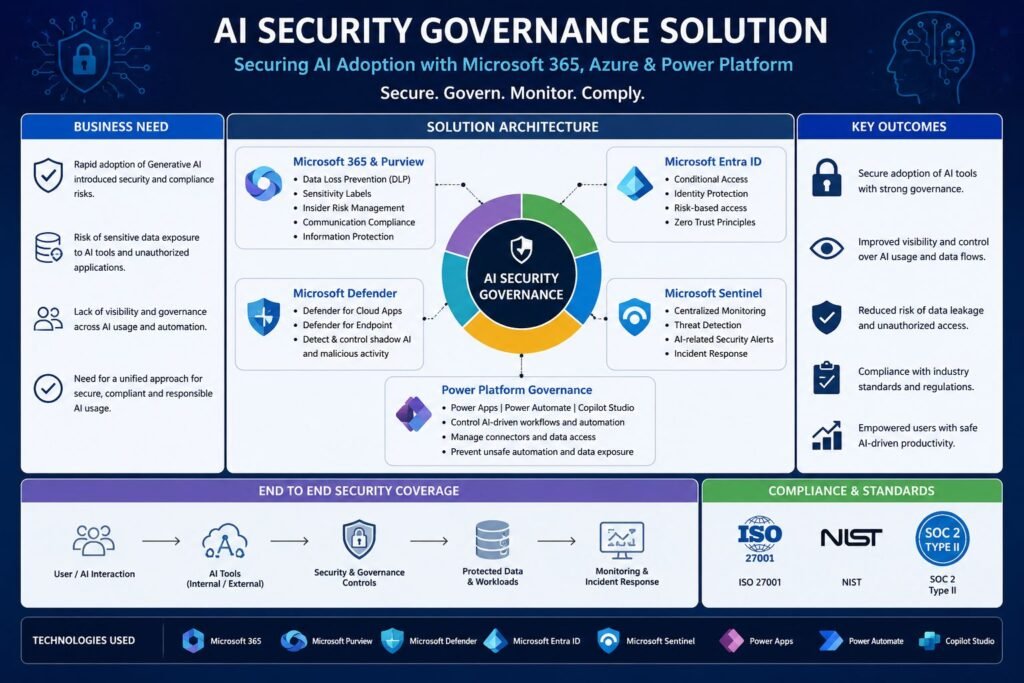
Establish a Centralized AI Governance Model
One of Microsoft’s key recommendations is creating a centralized governance model for all AI applications and AI agents across the organization.
Every AI system should be:
- Identifiable
- Governed
- Observable
- Secure
- Accountable
Business leaders should always be able to answer:
- What AI agents exist?
- Who owns them?
- What data can they access?
- What actions can they perform?
- How are they monitored?
A centralized governance structure eliminates fragmented decision making and ensures consistent policy enforcement across departments.
In many organizations, AI governance responsibilities naturally align with existing cloud governance, security, and compliance teams rather than creating entirely new governance structures.
Need Help Building an AI Governance Framework?
Ensure your AI initiatives align with security, compliance, and business objectives from day one. Book a consultation with NG Cloud Security to assess your AI readiness and governance strategy.
Maintain an AI Agent Registry
One of the most overlooked governance requirements is maintaining visibility into AI assets.
Organizations cannot govern AI systems they cannot see.
Every AI application, Copilot, chatbot, and AI agent should be recorded in a centralized inventory containing:
- Business owner
- Technical owner
- Purpose
- Data sources
- Access permissions
- Compliance requirements
- Cost allocation information
Maintaining a complete AI registry helps reduce shadow AI deployments and improves security oversight.
Implement Strong Identity and Access Governance
Identity remains one of the most important pillars of AI security.
Every AI agent should operate under a unique and managed identity.
Organizations should follow the principle of least privilege by granting AI systems access only to the resources required to perform their assigned tasks.
Strong AI identity governance should include:
- Role based access control
- Multi factor authentication
- Managed identities
- Privileged access reviews
- Conditional access policies
Organizations implementing AI governance can strengthen security using Microsoft Entra Suite and modern Identity and Access Management practices.
Strengthen Data Governance and Compliance
Data governance forms the foundation of responsible AI.
Organizations must clearly define how AI systems access, process, retain, and protect information throughout the AI lifecycle.
Protect Sensitive Information
AI solutions should only access data required for their intended purpose.
Sensitive information should be classified and protected using technologies such as:
- Data Loss Prevention
- Information Protection
- Sensitivity Labels
- Data Classification
Organizations can strengthen governance through Microsoft Purview Data Loss Prevention and Microsoft Purview Information Protection capabilities.
Enforce Data Residency Requirements
Many organizations operate under regulatory requirements that dictate where data must reside.
AI workloads should be deployed within approved geographic regions, ensuring compliance with local and international regulations.
Define Data Retention Policies
Organizations should establish clear retention periods for:
- AI conversation history
- Memory stores
- Logs
- Training datasets
- Generated outputs
A comprehensive Microsoft Purview Data Lifecycle and Records Management strategy helps organizations manage information responsibly throughout its lifecycle.
Align AI Governance with Responsible AI Principles
Microsoft emphasizes Responsible AI as a core governance requirement.
Organizations should establish controls that promote:
- Fairness
- Transparency
- Accountability
- Reliability
- Privacy
- Security
- Inclusiveness
Users should understand when they are interacting with AI systems, and organizations should maintain accountability for AI generated outcomes.
Regular reviews help ensure AI systems continue to operate according to organizational values and compliance requirements.
Protect AI Systems from Emerging Security Threats
AI systems introduce new attack vectors that traditional security programs may not fully address.
Common AI security threats include:
- Prompt injection attacks
- Data poisoning
- Credential theft
- Model manipulation
- Unauthorized tool access
- Sensitive data exposure
Organizations should incorporate AI specific security controls into existing cybersecurity programs.
Implement AI Threat Detection
Continuous monitoring is essential for detecting abnormal AI behavior.
Security teams should monitor:
- AI interactions
- Access patterns
- User activity
- Data movement
- Security alerts
Organizations can enhance visibility through Microsoft Sentinel and Microsoft Defender for XDR integrations.
Conduct AI Red Team Testing
Before deployment, organizations should test AI systems against realistic attack scenarios.
Adversarial testing helps identify vulnerabilities related to:
- Prompt injection
- Jailbreak attempts
- Data leakage
- Unsafe outputs
Regular testing significantly improves AI resilience and security posture.
Apply Zero Trust Principles to AI
AI systems should never be exempt from security policies.
Organizations should apply a Zero Trust approach where every request is verified, authenticated, and continuously monitored.
Core Zero Trust principles include:
- Verify explicitly
- Use least privilege access
- Assume breach
Organizations adopting AI can further strengthen governance by implementing a Zero Trust architecture and leveraging dedicated Zero Trust security services.
Monitor AI Activity and Manage Costs
As AI adoption scales, organizations require visibility into usage patterns and operational expenses.
AI governance should include monitoring for:
- Token consumption
- API usage
- Compute utilization
- User adoption
- Agent activity
- Department level spending
Cost allocation tags help organizations attribute expenses to specific projects, business units, or use cases.
Establishing governance around AI spending prevents budget overruns and improves operational transparency.
Standardize AI Development Practices
Microsoft recommends standardizing AI development frameworks, protocols, and deployment methods across the organization.
This approach provides:
- Consistency
- Security
- Maintainability
- Interoperability
Organizations should establish approved standards for:
- AI frameworks
- APIs
- Integrations
- Data access methods
- Agent communication protocols
This reduces operational complexity and accelerates secure AI adoption.
Prepare a Secure AI Environment
Before deploying AI solutions, organizations should ensure their environments support governance requirements from the beginning.
This includes:
- Identity governance
- Security controls
- Networking policies
- Compliance monitoring
- Logging and auditing
- Data protection controls
Organizations can further strengthen readiness through an Azure Cloud Security Assessment and comprehensive Cloud Security Assessment processes.
Final Thoughts
AI adoption is no longer a future initiative. It is becoming a core business capability across industries. However, successful AI implementation requires more than deploying models and agents. It requires governance, compliance, security, accountability, and operational visibility.
The Microsoft Cloud Adoption Framework provides organizations with a practical roadmap for governing and securing AI throughout its lifecycle. By establishing centralized governance, implementing strong identity controls, protecting sensitive data, monitoring AI behavior, and aligning AI initiatives with existing cloud governance models, organizations can adopt AI confidently while reducing risk.
Businesses that prioritize Governance and Security for AI today will be better positioned to scale innovation, maintain compliance, strengthen trust, and maximize the long term value of their AI investments.
Frequently Asked Questions
What is AI governance in the Microsoft Cloud Adoption Framework?
AI governance refers to the policies, processes, and controls used to manage AI systems responsibly. It includes compliance, data protection, risk management, accountability, monitoring, and operational oversight.
Why is AI security important?
AI systems can access sensitive information, interact with external systems, and make decisions. Without proper security controls, organizations risk data breaches, compliance violations, and operational disruption.
Which Microsoft tools help with AI governance?
Key Microsoft solutions include Microsoft Purview, Microsoft Entra ID, Microsoft Defender for Cloud, Microsoft Sentinel, Azure Policy, Azure Monitor, Azure AI Foundry, and Microsoft Copilot for Security.
How does Zero Trust support AI security?
Zero Trust ensures every AI interaction is continuously verified and monitored. It limits access permissions and reduces the risk of unauthorized activity or data exposure.
What is the role of Microsoft Purview in AI compliance?
Microsoft Purview helps organizations classify data, apply sensitivity labels, enforce Data Loss Prevention policies, manage records, and support regulatory compliance requirements for AI workloads.
Frequently Asked Questions (FAQ)
- Why is AI Security and Governance important for businesses?
As organizations adopt AI technologies such as Microsoft Copilot, ChatGPT, and other AI-powered tools, sensitive business information may become accessible to users and AI systems. AI Security and Governance help organizations protect confidential data, maintain regulatory compliance, reduce security risks, and ensure AI is used responsibly across the business.
- How does Microsoft Purview help secure AI data?
Microsoft Purview provides comprehensive data security, compliance, and governance capabilities that help organizations securely adopt AI. It discovers and classifies sensitive information, applies protection policies, monitors data usage, and helps prevent unauthorized access or data leakage through AI applications and services.
- Can Microsoft Purview prevent sensitive data from being shared with AI tools?
Yes. Microsoft Purview Data Loss Prevention (DLP) policies can identify sensitive information and prevent it from being shared with unauthorized users, external recipients, or unapproved AI applications. This helps reduce the risk of data exposure and compliance violations.
- What is Data Security Posture Management (DSPM) for AI?
DSPM for AI helps organizations understand how their data is exposed, accessed, and used by AI applications. It identifies sensitive data risks, detects overexposed information, monitors AI interactions, and provides recommendations to strengthen security controls before and during AI adoption.
- How does DSPM for AI improve AI security?
DSPM for AI continuously evaluates data security risks, identifies excessive permissions, highlights sensitive content accessible to AI systems, and helps organizations implement controls to reduce data leakage and unauthorized access risks.
- What is Communication Compliance, and how does it help?
Communication Compliance helps organizations monitor business communications across email, Microsoft Teams, and supported collaboration platforms. It can detect policy violations, inappropriate communications, sensitive data sharing, regulatory breaches, and misuse of AI-generated content, helping maintain a secure and compliant workplace.
- What is Insider Risk Management?
Insider Risk Management helps organizations identify potentially risky user activities that may lead to data leaks, intellectual property theft, compliance violations, or unauthorized sharing of confidential information. It enables security teams to investigate and respond to risks before they become serious incidents.
- Is Microsoft Purview recommended before deploying Microsoft Copilot?
Yes. Before deploying Microsoft Copilot, organizations should assess their data security posture. Microsoft Purview helps identify sensitive information, implement data protection controls, manage permissions, and reduce the risk of exposing confidential data through AI-powered experiences.
- How does Microsoft Purview support compliance requirements?
Microsoft Purview helps organizations meet regulatory and industry requirements by providing data classification, audit logging, retention policies, eDiscovery, Information Protection, Communication Compliance, Insider Risk Management, and governance controls. This supports frameworks such as GDPR, HIPAA, ISO 27001, NCA, SAMA, and other compliance standards.
- What business benefits can organizations expect from implementing AI Security and Governance?
Organizations can confidently adopt AI while reducing security and compliance risks. Key benefits include improved data protection, reduced risk of data breaches, stronger regulatory compliance, enhanced visibility into AI usage, protection of intellectual property, and greater trust in AI-powered business processes.
- How do DLP, Communication Compliance, Insider Risk Management, and DSPM for AI work together?
These capabilities provide a comprehensive AI security framework:
- Data Loss Prevention (DLP) protects sensitive information from unauthorized sharing.
- Communication Compliance monitors communications for policy violations and regulatory risks.
- Insider Risk Management detects risky user activities and potential data misuse.
- DSPM for AI identifies data exposure risks and strengthens AI security posture.
Together, they help organizations securely govern data, users, communications, and AI interactions.
- How can NG Cloud Security help?
NG Cloud Security helps organizations assess AI readiness, implement Microsoft Purview, deploy DLP and Information Protection, configure Communication Compliance and Insider Risk Management, establish AI Governance frameworks, and secure Microsoft Copilot and other AI solutions while meeting business and compliance requirements
Secure Your AI Journey with Confidence
From Microsoft Purview and Zero Trust to AI governance and compliance, NG Cloud Security helps organizations adopt AI securely while meeting regulatory requirements and business goals.
