
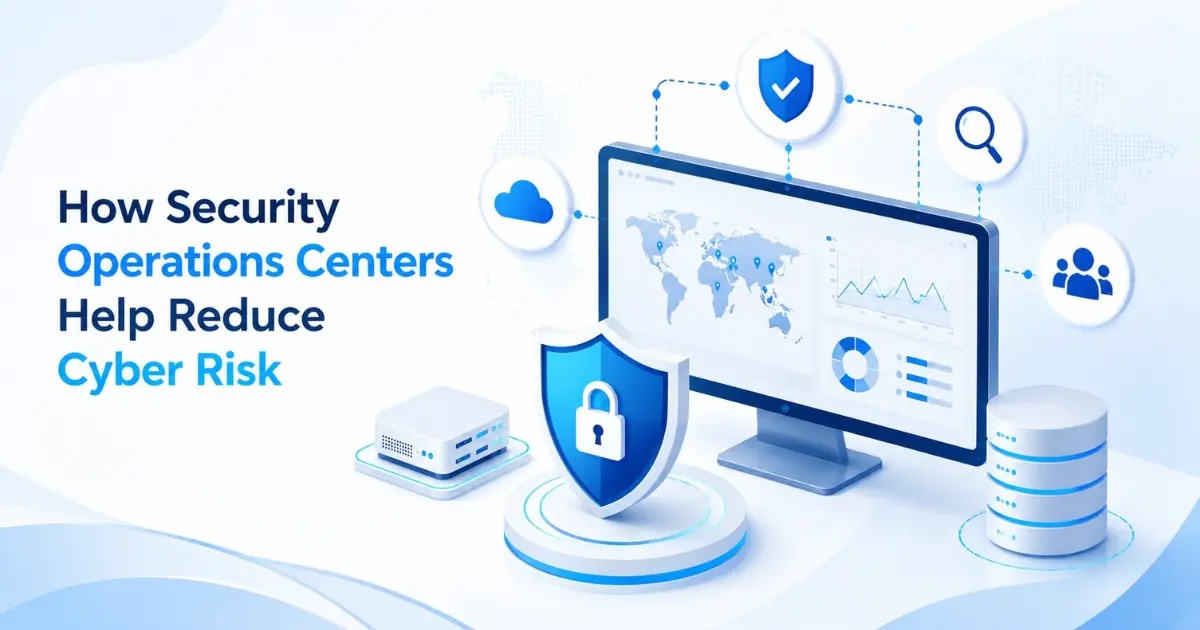
How Security Operations Centers Help Reduce Cyber Risk
Cyberattacks aren’t slowing down, and neither is the pressure on IT teams to catch them before they cause damage. A Security Operations Center, or SOC, is the team and technology stack responsible for monitoring, detecting, and responding to threats around the clock. For most organizations, the fastest and most cost-effective way to get that coverage is by outsourcing it — which is exactly where the benefits of managed SOC services come in.
This guide breaks down exactly how a SOC reduces cyber risk, what the real benefits of managed SOC services look like in practice, and how to evaluate a provider before you sign a contract.
What Is a Managed SOC?
A managed Security Operations Center is a SOC run by a third-party provider on your behalf — covering monitoring, threat detection, and incident response — rather than being built and staffed entirely in-house. Instead of hiring, training, and retaining a round-the-clock security team, you get access to an existing team and technology stack immediately.
For small and mid-sized organizations especially, this is where the benefits of managed SOC services become obvious: the same level of coverage a large enterprise security team provides, without the enterprise-sized budget or hiring timeline.
Why Cyber Risk Keeps Rising
Several converging trends are driving cyber risk higher across nearly every industry, making round-the-clock monitoring more necessary every year.
Expanding Attack Surfaces
Cloud adoption, remote work, and a growing number of connected devices mean there are simply more entry points for attackers to probe than there were five years ago.
Faster, More Automated Attacks
Attackers increasingly use automation themselves, scanning for misconfigurations and probing for weaknesses far faster than a small internal team can track manually.
Alert Fatigue and Analyst Burnout
A mid-sized organization’s security tools can generate thousands of alerts a day. In-house teams without dedicated SOC staff often can’t keep up, and real incidents can get lost in the noise.
Expanding Compliance Requirements
Regulatory frameworks keep expanding, and most now carry explicit breach-notification timelines, adding pressure to detect and report incidents quickly. Missing a notification window because an incident wasn’t detected in time can turn a technical problem into a legal and financial one.
None of this is solved by hiring more staff alone. This is precisely where the case for outsourcing becomes strongest.
Core Benefits of Managed SOC Services
The benefits of managed SOC services generally fall into six categories. Together, they explain why managed SOC adoption has grown steadily across nearly every industry.
1. 24/7 Continuous Monitoring
A managed SOC watches your environment around the clock, including nights, weekends, and holidays — coverage that’s extremely expensive to replicate with an in-house team alone.
2. Access to Specialized Expertise
Managed SOC providers employ analysts who specialize in threat detection full time, along with access to threat intelligence feeds and tooling most individual organizations couldn’t justify building themselves.
3. Faster Threat Detection and Response
With dedicated staff and mature processes, managed SOC teams typically detect and contain incidents faster than a generalist IT team handling security as one of many responsibilities.
4. Predictable Costs and Lower Overhead
Outsourcing converts the unpredictable cost of hiring, training, and retaining a security team into a predictable monthly cost, freeing up budget and internal headcount for other priorities.
5. Scalability as You Grow
A managed SOC scales with you. As you add cloud services, offices, or employees, monitoring coverage expands without you needing to hire additional in-house analysts.
6. Compliance and Audit Support
Most managed SOC providers deliver the reporting and audit trails needed for frameworks like SOC 2, HIPAA, or ISO 27001 as a built-in part of the service, rather than a separate project. For organizations in regulated industries, this alone often justifies the switch, since building equivalent reporting internally usually requires dedicated compliance staff on top of the security team itself.
Why it matters: Taken together, these benefits of managed SOC services explain why organizations that switch from an ad-hoc internal setup to a managed provider typically see faster detection and lower total security costs within the first year.
Not Sure If a Managed SOC Is Right for Your Organization?
NG Cloud Security can walk you through the benefits of managed SOC services specific to your environment and show you exactly what coverage would look like.
How AI and Machine Learning Strengthen a Managed SOC
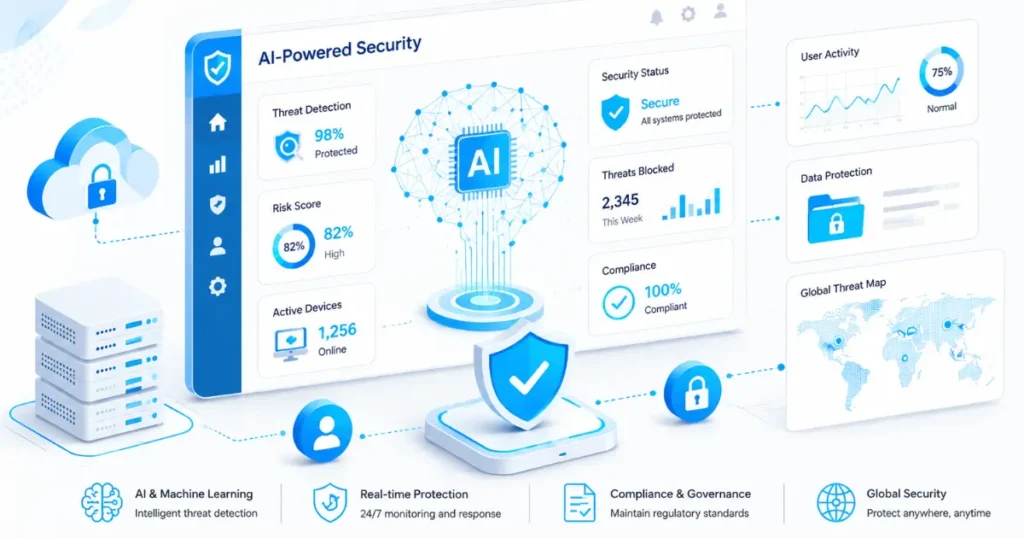
Modern managed SOC providers increasingly build AI and machine learning directly into their detection pipeline, most commonly through tools like Microsoft Sentinel and Microsoft Copilot for Security. This adds another layer to the core benefits of managed SOC services beyond staffing and coverage alone.
- Anomaly detection models trained on your environment’s normal behavior, reducing false positives
- Automated correlation across identity, endpoint, and network signals to catch multi-stage attacks
- Natural-language incident summaries that help analysts triage faster
- Predictive risk scoring that helps prioritize which alerts need immediate human attention
Microsoft’s own guidance on Microsoft Sentinel and AI-driven threat detection outlines how these capabilities integrate directly into an existing SOC workflow.
How to Measure SOC Effectiveness
Whether you’re evaluating a managed provider or your own internal team, effectiveness comes down to a handful of measurable indicators rather than a general sense of confidence.
Mean Time to Detect (MTTD)
This measures how long it takes to identify that an incident is happening at all. Every hour an attacker operates undetected increases the eventual cost of a breach.
Mean Time to Respond (MTTR)
Once a threat is confirmed, MTTR measures how quickly it gets contained — one of the areas where the benefits of managed SOC services show up most clearly, since dedicated teams respond faster than generalist staff.
Alert-to-Incident Ratio
A healthy SOC converts a meaningful share of alerts into confirmed incidents worth investigating, rather than drowning analysts in low-value noise.
Coverage Across Your Environment
A SOC is only as strong as what it actually monitors. Gaps in cloud coverage or unmanaged devices create blind spots no amount of detection sophistication can compensate for.
Together, these four measurements give you a much more concrete picture of SOC performance than uptime alone, and they’re the numbers worth asking any provider to report on regularly. If a prospective provider can’t produce these metrics on request, that’s a meaningful signal about how mature their operation actually is, regardless of what their sales materials claim.
Common Objections to Outsourcing a SOC — and What Actually Happens
A few concerns come up repeatedly when organizations consider a managed SOC. Most don’t hold up once you look at how these engagements actually run in practice.
We’ll lose visibility into our own security.
In practice, the opposite is usually true. Managed SOC providers give you a live dashboard and regular reporting most in-house teams never had time to build themselves. You typically end up with more visibility, not less, simply because monitoring becomes someone’s full-time job instead of a side responsibility.
Our environment is too specific for an outside team to understand.
Reputable providers spend real onboarding time learning your environment, your normal traffic patterns, and your critical assets before going live. That baseline is exactly what makes anomaly detection accurate in the first place.
It’s just cheaper to keep it in-house.
On paper, an internal hire might look cheaper than a subscription. In practice, one analyst can’t provide round-the-clock coverage, and the true cost of building a team — salaries, tooling, training, and turnover — is usually far higher than organizations initially budget for.
We’ll be locked into one vendor.
Most managed SOC contracts are structured with defined terms and clear exit provisions, and integrate with the security tools you already use rather than replacing them outright. It’s worth confirming this explicitly during the sales process rather than assuming it.
In-House SOC vs. Managed SOC Services
| Factor | In-House SOC | Managed SOC Services |
| Coverage | Limited by staffing and shift schedules | True 24/7/365 coverage |
| Setup time | Months to hire, train, and tool up | Operational in weeks |
| Cost structure | Fixed salaries, tooling, and training costs | Predictable subscription-based pricing |
| Expertise depth | Limited to whoever you can hire and retain | Access to a full specialized team |
| Scalability | Requires new hires to scale | Scales with the service, not headcount |
Our honest take: an in-house SOC can make sense for very large enterprises with the budget for a full round-the-clock team. For most other organizations, the benefits of managed SOC services — cost, coverage, and speed — outweigh the appeal of building it all internally.
What to Look for in a Managed SOC Provider
Not every managed SOC provider delivers the same level of service, and the differences usually only become obvious after a real incident happens.
True 24/7 Coverage
Confirm round-the-clock staffing, not an on-call rotation that adds delay when it matters most.
Transparent SLAs
Response time commitments should be defined in writing, with clear escalation paths for high-severity incidents.
Real AI/ML Detection Capability
Ask for a walkthrough of how detection actually works, not just a claim on a slide.
Integration With Your Existing Environment
If you’re already running on Microsoft Azure or another cloud platform, confirm the provider has direct experience integrating with it.
Compliance-Ready Reporting
Reporting should map directly to whatever framework you’re working under — SOC 2, HIPAA, or ISO 27001 — without extra translation work on your end.
Frequently Asked Questions
What are the main benefits of managed SOC services?
The core benefits are 24/7 monitoring, access to specialized security expertise, faster threat detection and response, predictable costs, scalability, and built-in compliance support.
Is a managed SOC cheaper than building an in-house team?
In most cases, yes. Hiring, training, and retaining a round-the-clock in-house security team costs significantly more than a subscription-based managed SOC, especially for small and mid-sized organizations.
How quickly can a managed SOC detect a threat?
It depends on the provider’s detection technology, but AI/ML-augmented managed SOCs commonly detect high-confidence threats within minutes, compared to hours or longer with manual-only monitoring.
Can a managed SOC work alongside my existing IT team?
Yes. Most managed SOC engagements are designed to complement an internal IT team, handling dedicated security monitoring while your team focuses on day-to-day operations.
Does a managed SOC help with compliance requirements?
Yes — most providers include audit-ready reporting mapped to frameworks like SOC 2, HIPAA, or ISO 27001 as part of the service.
What size organization actually needs managed SOC services?
Any organization without the budget or staffing for a dedicated round-the-clock internal security team benefits from the shift — in practice, that includes most small and mid-sized businesses.
Ready to See the Benefits of Managed SOC Services for Your Business?
Talk to NG Cloud Security about managed SOC coverage, AI-driven threat detection, and building 24/7 protection into your existing environment.
