

Top 10 Benefits Of Serverless Computing For Modern Business Growth
Serverless computing is changing how modern businesses build and scale applications. From my experience working with cloud environments and security focused architectures, I have seen organizations move toward serverless models to simplify operations, reduce costs, and improve agility.
If you are exploring the benefits of serverless computing, this guide will help you understand why it has become a key part of digital transformation strategies.
What Is Serverless Computing
Serverless computing is a cloud execution model where the cloud provider manages infrastructure, scaling, and maintenance. Developers only focus on writing code while the platform handles provisioning and execution.
Despite the name, servers still exist, but they are abstracted away from the user.
Why Serverless Computing Matters Today
Businesses today demand speed, flexibility, and cost control. With increasing adoption of microservices and real time applications, traditional infrastructure often becomes a bottleneck.
Serverless computing addresses these challenges by enabling:
- Faster development cycles
- Efficient resource utilization
- Reduced operational complexity
This is why many organizations investing in cloud security solutions are also moving toward serverless architectures.
Top 10 Benefits Of Serverless Computing
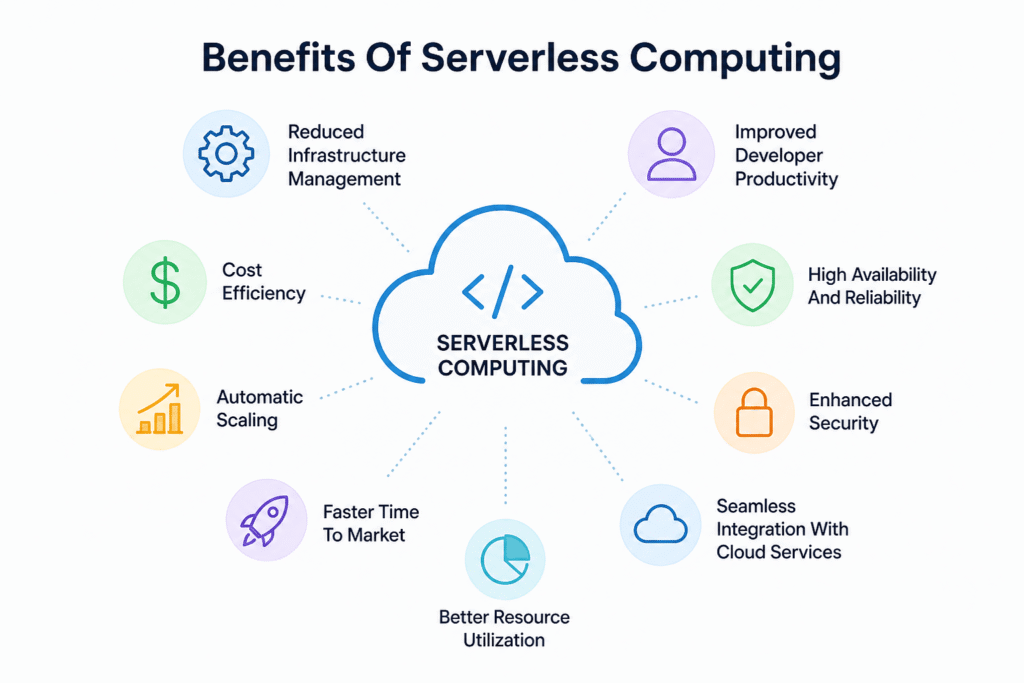
1. Reduced Infrastructure Management
Serverless eliminates the need to manage servers, patch systems, or handle capacity planning. This allows teams to focus on innovation instead of maintenance.
2. Cost Efficiency
One of the biggest benefits of serverless computing is its pay per use pricing model. You only pay when your code runs.
This is especially useful for businesses with unpredictable workloads and aligns well with cloud managed services strategies.
3. Automatic Scaling
Serverless platforms automatically scale based on demand. Whether traffic spikes suddenly or grows steadily, the system adjusts without manual intervention.
4. Faster Time To Market
Without infrastructure setup, development becomes faster. Teams can deploy applications quickly and release updates without delays.
5. Improved Developer Productivity
Developers can focus entirely on writing business logic. This leads to cleaner code, faster delivery, and better collaboration across teams.
6. High Availability And Reliability
Serverless platforms are built with redundancy and failover capabilities. Applications remain available even during unexpected failures.
7. Enhanced Security
Cloud providers handle infrastructure level security such as patching and updates. However, application level security still remains important.
This is where approaches like Zero Trust security services play a critical role in securing serverless environments.
8. Seamless Integration With Cloud Services
Serverless integrates easily with databases, storage, and analytics tools. This makes it easier to build modern, scalable applications.
9. Better Resource Utilization
Traditional servers often run below capacity. Serverless ensures resources are used only when needed, reducing waste and improving efficiency.
10. Supports Modern Application Development
Serverless is ideal for APIs, microservices, and event driven architectures. It aligns perfectly with modern development practices and cloud native strategies.
Popular Serverless Platforms
Some widely used serverless platforms include:
These platforms allow developers to deploy functions that run in response to events such as API calls or database updates.
Real World Use Cases Of Serverless Computing
Serverless is widely used across industries. Common use cases include:
- Web applications and APIs
- Real time data processing
- IoT applications
- AI and chatbot systems
Organizations investing in application modernization often use serverless to build scalable and flexible systems.
Serverless vs Traditional Cloud Computing
Serverless differs from traditional cloud models in several ways:
- Infrastructure is fully managed
- Scaling is automatic
- Cost is based on usage
- Deployment is faster
Traditional cloud setups require manual management, which increases complexity and operational overhead.
Disadvantages Of Serverless Computing
While the benefits of serverless computing are significant, it is important to understand its limitations.
Cold Start Latency
Functions may take time to start after inactivity, which can affect performance.
Vendor Dependency
Switching providers can be challenging due to differences in architecture.
Debugging Complexity
Distributed systems make troubleshooting more difficult.
Not Ideal For Long Running Tasks
Serverless is best suited for short execution workloads.
Security Considerations In Serverless
From my experience, security is often misunderstood in serverless environments. While infrastructure is managed by providers, businesses still need to focus on:
- Identity and access control
- Data protection
- Monitoring and logging
A strong foundation in security assessment and control helps ensure serverless applications remain secure and compliant.
Best Practices For Serverless Adoption
To get the most out of serverless computing:
- Design stateless applications
- Use microservices architecture
- Monitor performance continuously
- Implement strong security policies
Conclusion
Serverless computing is not just a trend but a strategic shift in how applications are built and deployed. It helps businesses reduce costs, improve scalability, and accelerate innovation.
From my experience, organizations that combine serverless architecture with strong cloud security and governance frameworks gain the most value.
If you are planning to modernize your IT environment, serverless computing can play a key role in achieving long term business growth.
Frequently Asked Questions
Is serverless computing cost effective
Yes, it is cost effective for applications with variable workloads since you only pay for actual usage.
Is serverless secure
Yes, but security depends on proper configuration and access control.
When should you avoid serverless
It may not be suitable for long running processes or highly predictable workloads.
Can serverless replace traditional cloud
Not completely. Many organizations use a hybrid approach depending on their needs.
