
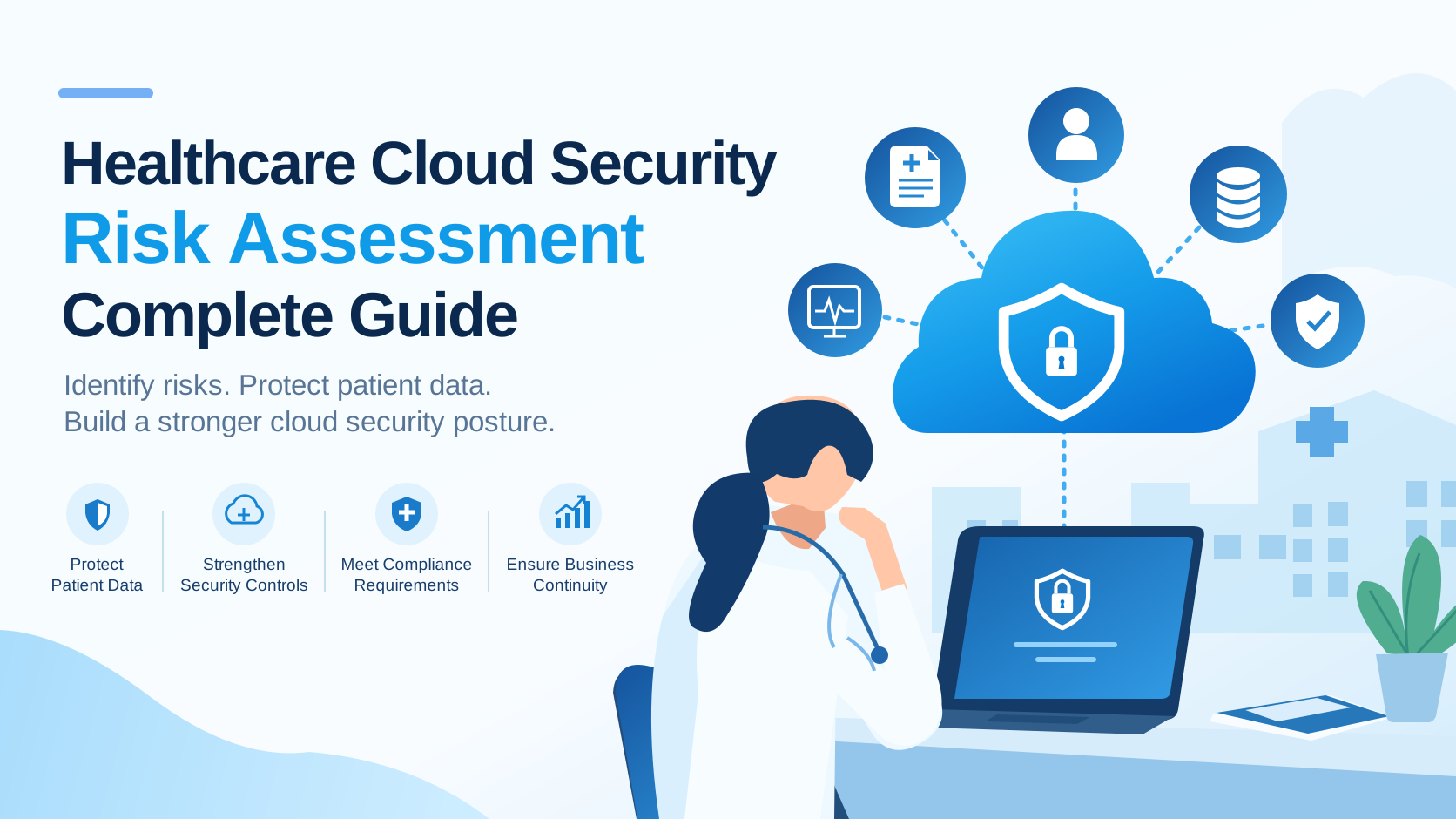
Healthcare Cloud Security Risk Assessment Complete Guide
Moving healthcare workloads to the cloud does not automatically make them secure or insecure. The real question is whether the organization understands where sensitive health information exists, who can reach it, how it is protected, and what happens when something goes wrong.
That is where a healthcare cloud security risk assessment becomes valuable.
A useful assessment should do more than produce a long list of vulnerabilities. It should help a healthcare organization understand which weaknesses could actually affect patient information, clinical operations, business continuity, and compliance responsibilities.
This is also why a generic security checklist rarely gives the complete picture. The risks depend on the organization’s applications, cloud architecture, identities, data flows, vendors, and operational processes.
What Should a Healthcare Cloud Risk Assessment Actually Tell You?
At the end of an assessment, I would want clear answers to 5 questions:
What sensitive information do we have?
Where does that information actually go?
Who can access it and under what conditions?
Which security controls would stop or limit unauthorized access?
If those controls fail, how quickly can we detect and respond?
These questions are more useful than simply asking whether encryption or multifactor authentication is enabled.
For example, an organization may have multifactor authentication enabled across its cloud environment but still have highly privileged accounts with excessive permissions. Another organization may encrypt its data but have weak logging, poor backup recovery, or no clear understanding of which third party applications can access the information.
The assessment needs to expose these relationships.
Start With the Data, Not the Cloud Console
One mistake I often see in cloud security projects is starting with the technology.
Teams open their Azure or other cloud console and begin reviewing configurations without first understanding the information that needs protection.
For healthcare, the better starting point is the data.
Identify where electronic protected health information is created, received, stored, processed, and transmitted. Then map the applications, users, services, vendors, and cloud resources connected to that information.
This approach makes the assessment much more meaningful because a low risk configuration issue becomes more important when it affects a system containing sensitive patient information.
HHS guidance similarly requires regulated organizations to assess risks to the confidentiality, integrity, and availability of ePHI rather than limiting the assessment to a particular cloud technology.
Organizations dealing with broader healthcare compliance requirements can also review their HIPAA compliance services to understand how cloud security fits into the wider compliance program.
Look Closely at Identity and Privileged Access
In many cloud environments, identity becomes the new security boundary.
A healthcare assessment should therefore examine more than whether users have accounts.
Look at privileged administrators, service accounts, guest users, inactive accounts, emergency access accounts, application identities, and third party integrations.
Then ask a more important question:
If one of these accounts were compromised today, what could the attacker reach?
This is where excessive permissions become particularly important.
An account may only need access to one healthcare application but may have inherited permissions across storage, databases, collaboration platforms, or administrative resources.
Reviewing Microsoft Entra ID controls can be particularly useful for organizations using Microsoft cloud services because identity, conditional access, authentication, and privileged access can directly influence the overall security posture.
Do Not Treat Encryption as the Finish Line
Encryption is important, but it is not a complete healthcare cloud security strategy.
HHS specifically notes that encryption alone does not address every requirement around confidentiality, integrity, and availability.
Consider a simple scenario.
A healthcare application stores encrypted patient information. The database is protected, but an administrator account is compromised. The attacker can authenticate legitimately and access the application.
The encryption may still be working exactly as designed.
The problem is identity and access control.
Now consider another scenario where the data is well protected but backups cannot be restored after a ransomware incident.
Confidentiality may be strong, but availability has become the problem.
This is why the assessment should examine data protection, identity security, access controls, backup recovery, monitoring, and resilience together.
Your data security services can provide a broader foundation for reviewing how sensitive information is protected across the environment.
Examine the Cloud Configuration That People Rarely Review
Cloud environments can accumulate configuration changes quickly.
A risk assessment should examine storage permissions, network exposure, security groups, administrative interfaces, logging, backup settings, database access, workload identities, and security policies.
But there is another question worth asking:
Who is responsible for each control?
Cloud security is based on shared responsibilities. A cloud provider may secure parts of the underlying service, while the healthcare organization remains responsible for controls it manages.
HHS guidance specifically emphasizes that healthcare organizations using cloud services need to understand their cloud environment so they can perform their own risk analysis and establish appropriate risk management measures.
That makes responsibility mapping an important part of the assessment.
Assess Third Party Access as Carefully as Employee Access
Healthcare organizations rarely operate in isolation.
They may use cloud based EHR platforms, analytics applications, billing systems, remote care platforms, backup providers, consultants, managed security services, and other technology vendors.
Each connection can introduce another path to sensitive information.
Ask:
What information does the vendor receive?
Does the vendor store or process ePHI?
What identities can access the environment?
Can access be restricted?
What happens when the contract ends?
Is the required contractual arrangement in place?
For cloud service providers that create, receive, maintain, or transmit ePHI on behalf of a covered entity or business associate, HHS states that a HIPAA compliant business associate agreement is required.
This makes vendor and third party access an important part of a healthcare cloud assessment rather than a separate procurement exercise.
Test Detection and Recovery, Not Just Prevention
Another common weakness is spending considerable effort preventing attacks while giving less attention to what happens after an attacker gets through.
A mature assessment should examine logging, alerting, investigation procedures, incident escalation, backup recovery, and business continuity.
Ask a practical question:
If someone accessed a privileged account at 2 AM, would the security team know what happened by 8 AM?
If the answer is unclear, the organization has a visibility problem.
For Microsoft environments, a Microsoft 365 security assessment can complement the broader cloud review by examining security controls across the Microsoft environment.
Turn Findings Into a Risk Based Action Plan
A report containing 70 findings is not necessarily useful.
The important part is understanding which findings deserve immediate attention.
For each significant finding, document:
What is exposed?
What could happen?
Which systems or information are affected?
What control is missing or ineffective?
Who should fix it?
What should be done first?
This creates a remediation plan rather than another compliance document.
HHS guidance also describes risk analysis as the foundation for deciding which safeguards are reasonable and appropriate for the organization’s environment.
Your security assessment and control approach can help connect identified risks with specific security controls and remediation activities.
A Risk Assessment Should Not End With the Report
Cloud environments change constantly.
A new application is deployed. A vendor is connected. A user becomes an administrator. A workload moves to another service. A new integration starts transferring sensitive information.
Any of these changes can alter the organization’s risk profile.
That is why I would treat the assessment as a starting point rather than a final compliance exercise.
The objective is to create a repeatable process where significant changes trigger security review and important findings are tracked until they are properly addressed.
For organizations looking at the wider environment, a structured cloud security assessment can provide a broader view of infrastructure, identity, workloads, data protection, and security controls.
Final Takeaway
A healthcare cloud security risk assessment is most valuable when it answers practical business and security questions rather than simply checking whether individual controls exist.
Start with the data. Understand the access paths. Map responsibility. Examine privileged identities and third party connections. Test whether monitoring would actually detect suspicious activity. Then turn the findings into a prioritized remediation plan.
The goal is not to make the cloud environment look secure on paper.
The goal is to understand what could go wrong, how serious it would be, and what should be done before it becomes a patient data, operational, or compliance problem.
