
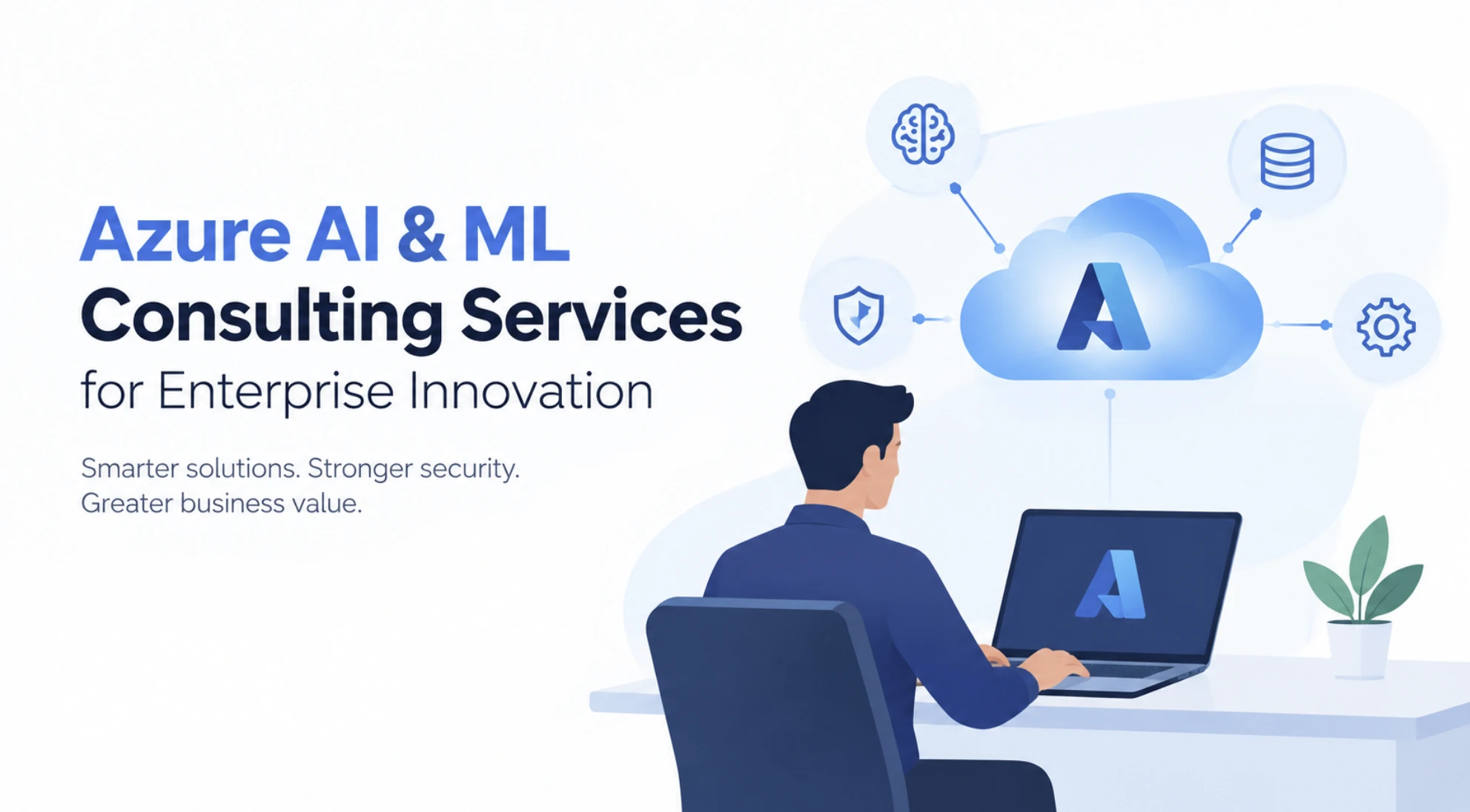
Azure AI & ML Consulting Services for Enterprise Innovation
Many enterprises are interested in AI, but the difficult part is rarely finding an AI model or creating a demonstration.
The difficult part is making AI work with the systems, data, security policies, people, and processes that already exist inside the business.
This is where Azure AI & ML consulting services become useful. The real value is not simply connecting an organization to Azure AI services. It is deciding where AI actually makes sense, what data should be used, how the solution should be secured, and how it can move from an experiment into a dependable business capability.
After working around cloud, security, and enterprise technology environments, one thing becomes clear: the organizations that get lasting value from AI usually start with the business problem rather than the technology.
Start With the Problem, Not the AI Model
A business may say, “We want to implement AI.”
That is not yet a project requirement.
A better starting point is a specific operational problem.
Is your support team spending hours searching internal documentation? Are sales teams struggling to identify useful information from large datasets? Is the finance department manually reviewing documents? Are operations teams making decisions using historical reports that could be analyzed more intelligently?
These questions lead to much better AI opportunities.
For example, an organization might discover that its first useful AI project is not a sophisticated autonomous application. It could simply be an intelligent knowledge assistant that helps employees find information across approved internal sources.
That smaller use case can be measured, secured, and improved before the organization expands into more complex applications.
Your Data May Be More Important Than Your Model
One of the most overlooked parts of an AI project is data readiness.
Businesses often have years of information spread across databases, Microsoft 365, business applications, file repositories, CRM platforms, and custom systems. That does not automatically mean the information is ready for machine learning or generative AI.
Before selecting an architecture, I would want to understand:
Where does the data come from?
Who owns it?
How accurate and current is it?
Does it contain sensitive information?
Who should be allowed to access it?
Can the data actually be used for the intended purpose?
These questions can completely change the architecture.
An organization with well governed data may be ready to move quickly. Another organization may need to address data quality, classification, access controls, or integration first.
This is also where Microsoft Power BI consulting services can complement an AI initiative, particularly when an organization first needs to improve how business data is organized, analyzed, and consumed.
Do Not Build AI in Isolation From Your Cloud Environment
AI applications rarely exist by themselves in a mature enterprise.
They interact with identity systems, applications, databases, APIs, networks, storage, monitoring platforms, and security controls.
This means the AI architecture should fit into the wider cloud environment.
For organizations already modernizing their infrastructure, Azure migration services can provide part of the foundation needed for moving applications and workloads into Azure.
For an existing application that needs to become more suitable for intelligent capabilities, application modernization may be relevant before introducing advanced AI functionality.
The goal should be an architecture where AI becomes part of the technology environment rather than another disconnected platform that the IT team has to manage.
Generative AI Creates a Different Security Problem
Traditional applications generally follow predictable rules about what users can access.
Generative AI can make information easier to discover and summarize, which is useful, but it also creates a new question:
What happens when an AI application can access information that a user should not see?
This is why permissions and data boundaries need to be designed carefully.
An internal AI assistant should not automatically become a shortcut around existing access controls. If sensitive information is connected to an AI system, identity, authorization, data classification, monitoring, and retrieval controls all become important.
This is where AI security governance becomes more than a compliance exercise. It becomes part of the application architecture.
Organizations with broader governance requirements can also evaluate AI governance and compliance services when defining policies, controls, and accountability around AI adoption.
The Proof of Concept Is Not the Finish Line
This is one of the biggest differences between an interesting AI demonstration and an enterprise solution.
A proof of concept might work perfectly with a small dataset and a few users.
Production is different.
What happens when 5,000 employees use it?
What happens when the underlying data changes?
Who monitors the model?
How do you identify incorrect responses?
What happens when the application becomes unavailable?
How are costs controlled?
How is access removed when an employee leaves?
These operational questions need answers before an AI solution becomes business critical.
Azure Machine Learning and related Azure capabilities can support model development, deployment, monitoring, and lifecycle management, but the technology still needs to be designed around the organization’s operating model.
Where Azure AI Can Deliver Practical Value
The strongest use cases are usually those where AI improves an existing process rather than simply adding an AI feature.
For example, machine learning can help identify unusual patterns in operational data. Intelligent document processing can reduce repetitive manual review. Natural language capabilities can make enterprise information easier to search. Generative AI can help employees summarize large amounts of approved information.
The business case should then be measurable.
That might mean reducing processing time from 3 hours to 30 minutes, improving response times, reducing manual review, increasing the accuracy of forecasting, or allowing employees to find information without depending on another team.
Those measurements make it easier to determine whether the AI investment is actually delivering value.
A Better Way to Approach Enterprise AI
A practical AI roadmap normally starts with a small number of high value use cases.
First, understand the business process.
Then assess the data.
After that, determine the appropriate AI approach and Azure architecture.
Security and governance should be designed alongside the solution rather than added after development.
Finally, establish measurable success criteria before moving into production.
This approach may sound less exciting than immediately launching an advanced AI application, but it creates something much more valuable: an AI capability that the business can actually operate and trust.
Building AI That Can Grow With the Business
AI adoption should not be treated as a one time technology project.
Models change. Data changes. Business requirements change. Regulations change. User expectations change.
A sustainable AI strategy therefore needs architecture, security, governance, monitoring, and continuous improvement from the beginning.
That is the real purpose of Azure AI & ML consulting services. It is not simply helping an organization use Azure AI. It is helping turn an AI opportunity into a secure, measurable, and scalable business capability.
The most important question is therefore not, “Which AI technology should we use?”
It is:
“Which business problem are we solving, and what would success look like if we solved it well?”
That is where a meaningful enterprise AI strategy begins.
