
Why Small Businesses Are Outsourcing Security Operations Centers
SOC managed services for small business are no longer a luxury reserved for enterprise organizations with large IT budgets. They have become the practical answer to a threat landscape that does not distinguish between a five-person accounting firm and a Fortune 500 company.
Small businesses are targeted by cybercriminals at nearly four times the rate of larger organizations, according to 2026 industry data from Saggis. A small business without dedicated security staff gets breached an average of 207 days before anyone notices, according to IBM’s 2025 Cost of a Data Breach Report. By the time the breach is discovered, the damage is done.
The managed services market has responded. Ninety percent of organizations now prefer outsourced or hybrid SOC models, with only nine percent planning to build an in-house SOC entirely, according to Kaspersky’s 2026 research. For small businesses, this shift is driven by seven clear reasons that make SOC managed services not just practical but necessary.
What Are SOC Managed Services for Small Business?
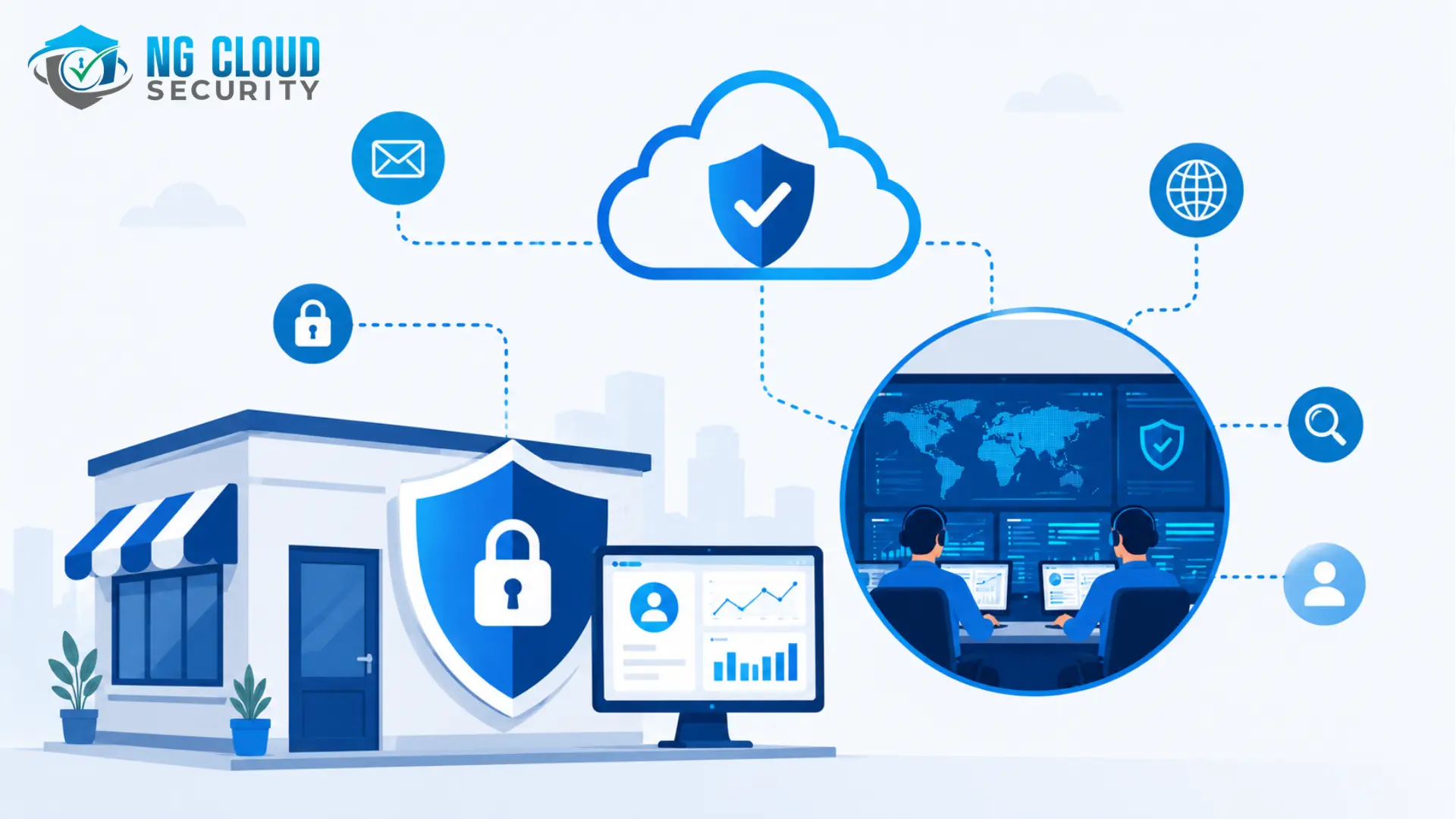
SOC managed services for small business provide a fully outsourced security operations center — analysts, tools, and processes — delivered as a monthly service without requiring the business to hire security staff, build infrastructure, or manage enterprise-grade software.
A managed SOC monitors your network, endpoints, email, cloud environment, and user identities around the clock. It detects threats, investigates alerts, and responds to incidents. For small businesses, it replaces the function that a full-time internal security team would perform — at a fraction of the cost. Managed IT security operations“
The terms managed SOC, SOC as a Service, and managed detection and response are often used interchangeably. The core offering is the same: continuous threat monitoring, expert investigation, and active incident response delivered by external security professionals.
The Threat Reality Small Businesses Face in 2026
The assumption that attackers focus on large enterprises is one of the most dangerous myths in small business security. Attackers target smaller companies precisely because they are less defended. Automated attack tools do not discriminate by company size — they scan the internet for vulnerable systems and exploit them regardless of the organization behind the IP address.
Ransomware attacks on small businesses increased sixty-eight percent in 2025. The average data breach costs four point eight eight million dollars according to IBM research. Sixty percent of small businesses that suffer a significant cyberattack close within six months. And cyber insurance carriers in 2026 are requiring documented evidence of security controls — including continuous monitoring — as conditions of coverage.
For a deeper look at the threat environment facing small businesses, CISA’s SMB Resources (cisa.gov/resources-tools/resources/small-and-midsize-businesses) provide current guidance on risk management and security controls.
7 Reasons Small Businesses Are Outsourcing Their SOC
These are the seven drivers that are pushing small businesses toward SOC managed services in 2026.
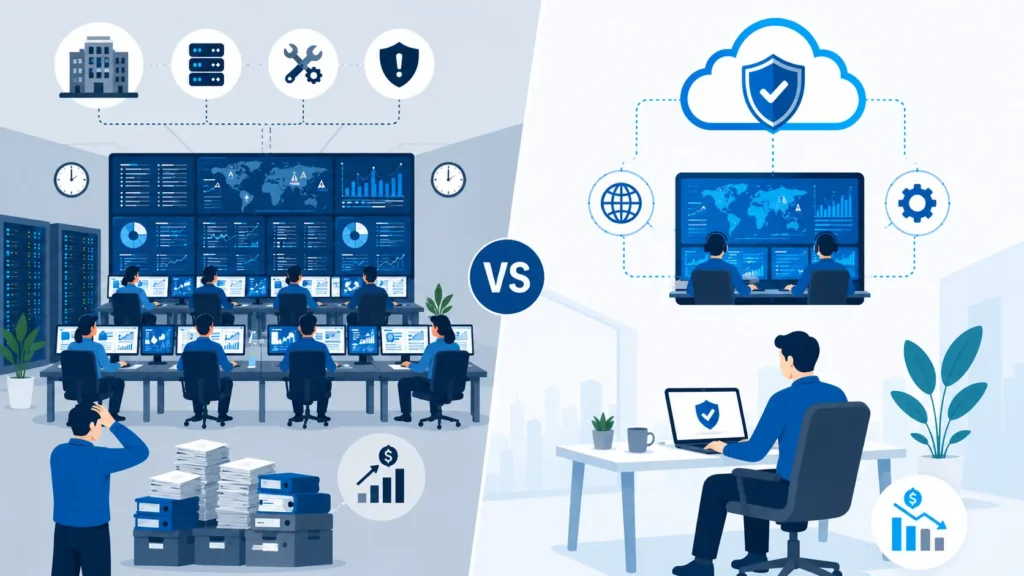
- Cost. Building an in-house SOC requires a security analyst team, SIEM software, endpoint detection tools, and management overhead. The first-year cost for even a minimal in-house SOC exceeds two hundred fifty thousand dollars. SOC managed services for small business deliver equivalent or greater coverage for one hundred to four hundred dollars per user per month — a predictable operational expense rather than a capital investment.
- Twenty-four-hour coverage. Attackers do not operate on business hours. Most breaches begin outside working hours when internal IT staff are unavailable. A managed SOC provides continuous coverage that a small internal team physically cannot sustain. Fifty-six percent of IT teams report that partnering with a managed provider resulted in better security, specifically because of the coverage gap it closed.
- Access to specialized expertise. Hiring a skilled SOC analyst is expensive and competitive. The global cybersecurity workforce shortage means small businesses often cannot recruit the specialists they need. SOC managed services for small business provide access to threat hunters, SIEM engineers, and incident responders whose expertise a small business could not otherwise afford or attract.
- Faster threat detection. A small business without security monitoring is breached an average of two hundred seven days before detection. Managed SOC providers track mean time to detect as a core performance metric. A well-run managed SOC reduces detection time from months to hours.
- Regulatory and compliance support. Healthcare, finance, legal, and other regulated industries require documented security monitoring as part of HIPAA, SOC 2, PCI DSS, and other frameworks. SOC managed services for small business provide the continuous monitoring, logging, and reporting that compliance auditors require. This is one of the fastest-growing reasons small businesses are moving to managed SOC services in 2026.
- Cyber insurance requirements. Insurers are raising the bar. Many carriers now require evidence of continuous security monitoring, MFA enforcement, and endpoint detection as conditions of coverage. SOC managed services satisfy these requirements and give small businesses the documentation carriers ask for at renewal.
- Scalability. A managed SOC grows with your business. As you add users, devices, cloud services, or geographic locations, the provider adjusts coverage. There is no hiring process, no new tooling investment, and no lag in coverage during growth phases.
Is Your Small Business Operating Without 24/7 Security Coverage?
NG Cloud Security provides SOC managed services for small business with continuous threat monitoring, expert incident response, and compliance reporting — at a cost that fits your budget.
What SOC Managed Services for Small Business Actually Include
Not all managed SOC providers deliver the same service. Before signing with any provider, confirm what is actually included in the engagement.
- Twenty-four seven threat monitoring across your network, endpoints, email, cloud workloads, and user identities
- Alert triage and investigation by human analysts who assess whether an alert represents a real threat
- Incident response support when a genuine threat is confirmed, including containment and remediation guidance
- SIEM management and log collection from your in-scope systems
- Threat intelligence integration so your monitoring benefits from current attack pattern data
- Compliance reporting including the logs, alerts, and evidence documentation that auditors and insurers require
- Regular reporting on key metrics including mean time to detect, mean time to respond, alert volume, and false positive rate
The metrics that matter most when evaluating SOC managed services for small business are mean time to detect and mean time to respond. A provider that cannot give you these numbers is not tracking them. Those numbers are how you know whether your provider is actively protecting your business or just monitoring it passively. For detailed guidance on evaluating provider performance, Verizon’s annual Data Breach Investigations Report (verizon.com/business/resources/reports/dbir/) is the most reliable independent reference available.
For growing businesses and SaaS companies that also need compliance alignment, our Microsoft 365 Security Assessment services and Conditional Access policy design capabilities complement the SOC monitoring layer with proactive configuration review. Learn more at ngcloudsecurity.com/services.
How NG Cloud Security Delivers SOC Managed Services for Small Business
NG Cloud Security provides SOC managed services for small business built specifically for organizations running Microsoft 365, Azure, and hybrid environments. Our service covers continuous monitoring, expert threat investigation, incident response, compliance reporting, and ongoing security advisory — without the overhead of building and maintaining an in-house security team.
What sets our approach apart is the combination of managed SOC coverage with deep Microsoft security expertise. Most small businesses are not just running generic IT infrastructure — they are running Microsoft 365, Exchange Online, SharePoint, Teams, and Intune-managed devices. Our monitoring covers the full Microsoft stack, with Conditional Access, identity threat detection, and Microsoft Defender integration included as standard.
Whether you are a growing professional services firm, a healthcare practice, a SaaS company, or a retail business handling customer data, our SOC managed services for small business scale to your environment, your compliance requirements, and your budget. Clients typically see meaningful improvement in detection coverage and incident response time within the first thirty days.
Frequently Asked Questions
How much do SOC managed services for small business cost?
SOC managed services for small business typically cost between one hundred and four hundred dollars per user per month in 2026, depending on the scope of coverage, the tools included, and the provider’s service level. For a small business with twenty to fifty employees, this translates to a predictable monthly investment significantly below the cost of hiring even a single dedicated security analyst. Most providers offer tiered pricing based on the number of endpoints or users in scope.
What is the difference between an MSSP and a managed SOC?
The terms are often used interchangeably. A Managed Security Service Provider delivers security services including monitoring, threat detection, and incident response. A managed SOC specifically refers to the security operations center function — the analysts, tools, and processes that handle continuous monitoring and response. Most MSSPs operate a SOC as part of their service delivery. Managed Detection and Response is a closely related term that emphasizes active response alongside monitoring, particularly at the endpoint level.
Do small businesses really need SOC managed services?
Yes. Small businesses are targeted at nearly four times the rate of large enterprises, and the average time to detect a breach without dedicated monitoring is over two hundred days. The financial and reputational damage from a breach that goes undetected for months is typically far greater than the annual cost of a managed SOC. Cyber insurance carriers and compliance frameworks are increasingly requiring continuous monitoring as a documented control, making managed SOC services a business necessity rather than an optional enhancement for regulated or insurance-dependent small businesses.
Final Thoughts
The decision to invest in SOC managed services for small business is no longer about whether you can afford it. It is about whether you can afford not to. Attackers are not waiting for small businesses to build in-house security teams. They are scanning for unmonitored systems right now.
The managed SOC model gives small businesses access to twenty-four hour coverage, specialized expertise, and the compliance documentation that insurers and auditors require — at a cost that scales with the business rather than requiring a capital investment that most small organizations cannot justify.
The question is not whether your small business needs security monitoring. It is who is doing it, and whether they are doing it well enough to catch a threat before it becomes a crisis.
Ready to Protect Your Business with SOC Managed Services?
Talk to our cybersecurity specialists about threat monitoring, incident response, compliance requirements, and managed SOC services tailored to your small business.
