
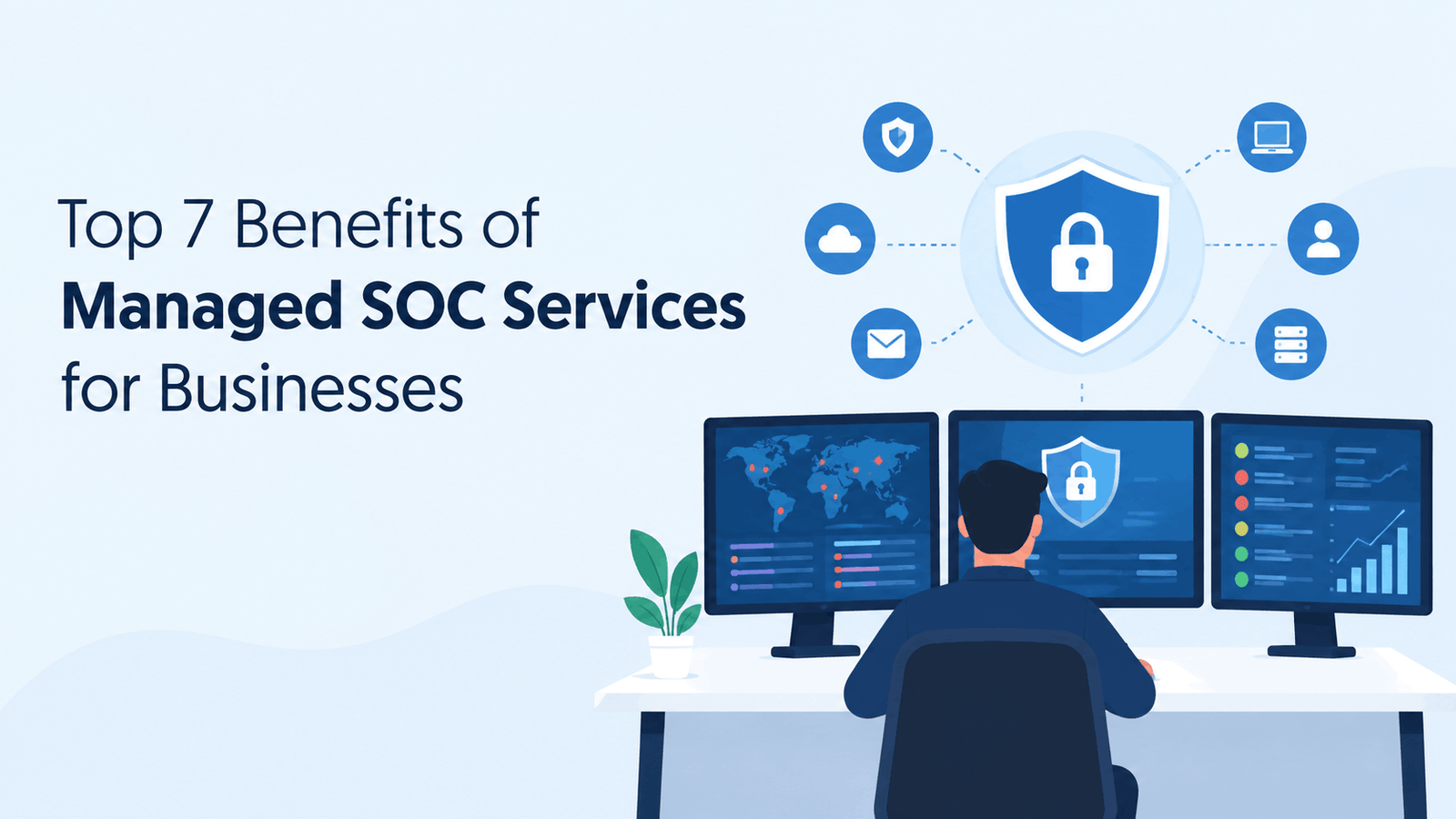
Top 7 Benefits of Managed SOC Services for Businesses
Most businesses already have security tools. They may have endpoint protection, Microsoft Defender, email security, firewalls, identity controls and cloud security products.
Yet having these tools does not necessarily mean someone is watching what they are reporting.
That is where the real security operations problem begins.
A security platform can generate hundreds or thousands of alerts, but an internal IT team may have limited time to investigate them. Some alerts are harmless. Others may indicate a compromised account, suspicious PowerShell activity, malware or an attacker moving through the environment.
The question is not simply, “Do we have security software?”
It is, “Who is watching the environment when something unusual happens, and what happens next?”
A managed Security Operations Center can address this operational gap. Here are 7 practical benefits businesses can gain from using one.
1. Security Monitoring Does Not Stop When Your IT Team Goes Home
Many security incidents do not happen at convenient times.
An employee could click a phishing link at 11 PM. An attacker could attempt to sign in using stolen credentials early in the morning. A compromised endpoint could start communicating with a suspicious destination while nobody from the IT team is available.
Without continuous monitoring, the first response may happen hours later.
A managed SOC provides ongoing security monitoring so that important events can be investigated outside normal working hours. This does not mean every alert requires an immediate response. The important part is having security analysts and defined processes available to determine which events actually matter.
For businesses with limited internal security coverage, this can make a meaningful difference.
2. Your IT Team Does Not Have to Investigate Every Alert
Security alert fatigue is a real operational problem.
When security products generate large volumes of notifications, IT teams can spend significant time reviewing events that turn out to be routine. Over time, this can make it harder to identify the alerts that deserve immediate attention.
This is where security operations become more than a technology problem.
A managed SOC can investigate events, correlate activity from different security sources and help separate potentially significant incidents from background noise.
This is particularly useful for organizations using several security platforms where the internal team does not have the capacity to continuously review everything.
For Microsoft environments, Microsoft Sentinel can provide a central platform for collecting and analyzing security information as part of the wider monitoring strategy.
3. You Get Security Expertise Without Building an Entire SOC
Running a security operations function internally requires more than buying a SIEM platform.
You need people who understand threat detection, endpoint telemetry, identity attacks, cloud activity, incident investigation and response procedures. You also need coverage when those people are unavailable.
For many small and mid sized businesses, building this capability internally can be difficult.
A managed SOC provides access to security analysts and established operational processes without requiring the organization to create every part of the function itself.
This can be especially valuable when the internal IT team is strong technically but does not have dedicated security operations expertise.
4. Different Security Tools Start Making More Sense Together
A common problem I see in security environments is that businesses have plenty of data but limited visibility.
One tool reports a suspicious login. Another reports an unusual endpoint process. An email security platform detects a phishing attempt. Identity logs show activity from an unfamiliar location.
Looking at each event separately may not reveal much.
Looking at them together can tell a completely different story.
A managed SOC can correlate security signals across endpoints, identities, networks, applications and cloud environments. Technologies such as Defender for XDR can also help organizations connect security signals across Microsoft environments.
The practical benefit is not simply having more dashboards. It is getting closer to the actual sequence of events.
5. Security Incidents Can Have a Defined Escalation Process
When a suspicious event is discovered, confusion about ownership can waste valuable time.
Who investigates it?
Who contacts the affected employee?
Who isolates the endpoint?
Who checks whether other accounts were compromised?
Who informs management?
A managed SOC can establish an escalation process before an incident occurs. Depending on the service, the provider can investigate alerts, classify incidents and escalate confirmed or high priority events to the appropriate internal stakeholders.
This matters because incident response is much easier when responsibilities are understood before the pressure of an actual security event.
6. You Can Strengthen Security Without Adding More Work to IT
Your IT team already has enough operational responsibilities.
They may be managing Microsoft 365, cloud infrastructure, endpoints, user accounts, applications and business support requests. Expecting the same team to continuously monitor security events can create competing priorities.
A managed SOC can take on the continuous monitoring and investigation workload while the internal team retains control over business systems and decisions.
This approach can work particularly well alongside cloud managed services, where organizations already use external expertise for ongoing technology operations.
The objective is not to replace internal IT. It is to make sure security monitoring does not become another task that gets postponed when something more urgent appears.
7. Security Monitoring Becomes Part of a Larger Security Strategy
A SOC should not operate as an isolated security function.
The information discovered through continuous monitoring can reveal weaknesses in identity controls, endpoint protection, cloud configurations, access policies and incident response procedures.
For example, repeated suspicious login attempts may lead to a review of identity controls. Recurring endpoint alerts may indicate the need for better device protection. Unexpected cloud activity may justify a broader cloud security assessment.
This creates an important feedback loop.
Monitoring identifies what is happening. Investigation explains why it is happening. The organization can then improve its controls based on what it learns.
That is where the long term value of managed security operations becomes more apparent.
What Should You Look for in a Managed SOC?
Not every managed SOC service works in the same way.
Before choosing a provider, ask what actually happens after an alert is generated. Does a security analyst investigate it, or does the platform simply send another notification? What technologies can the SOC monitor? How are incidents classified? What is the escalation process? Is there support outside business hours? What reporting will your team receive?
These questions are often more important than the number of security tools included in the service.
For organizations with compliance requirements, security monitoring can also contribute to a broader security program. For example, ISO 27001 consulting services can address the wider information security management requirements rather than treating SOC monitoring as a standalone solution.
The Real Value of a Managed SOC
The main reason businesses consider managed SOC services is not because another security dashboard is needed.
It is because security tools are only useful when someone can interpret their signals and take appropriate action.
A managed SOC can provide that operational layer through continuous monitoring, investigation, security expertise and defined incident escalation.
For a business with a small security team, growing cloud environment or increasing volume of security alerts, that capability can be difficult to build and maintain internally.
The right question, therefore, is not simply whether your business has enough security tools. Ask whether your organization has the people, processes and coverage needed to act when those tools identify something unusual.
That is where managed security operations can become a practical part of your cybersecurity strategy.
