
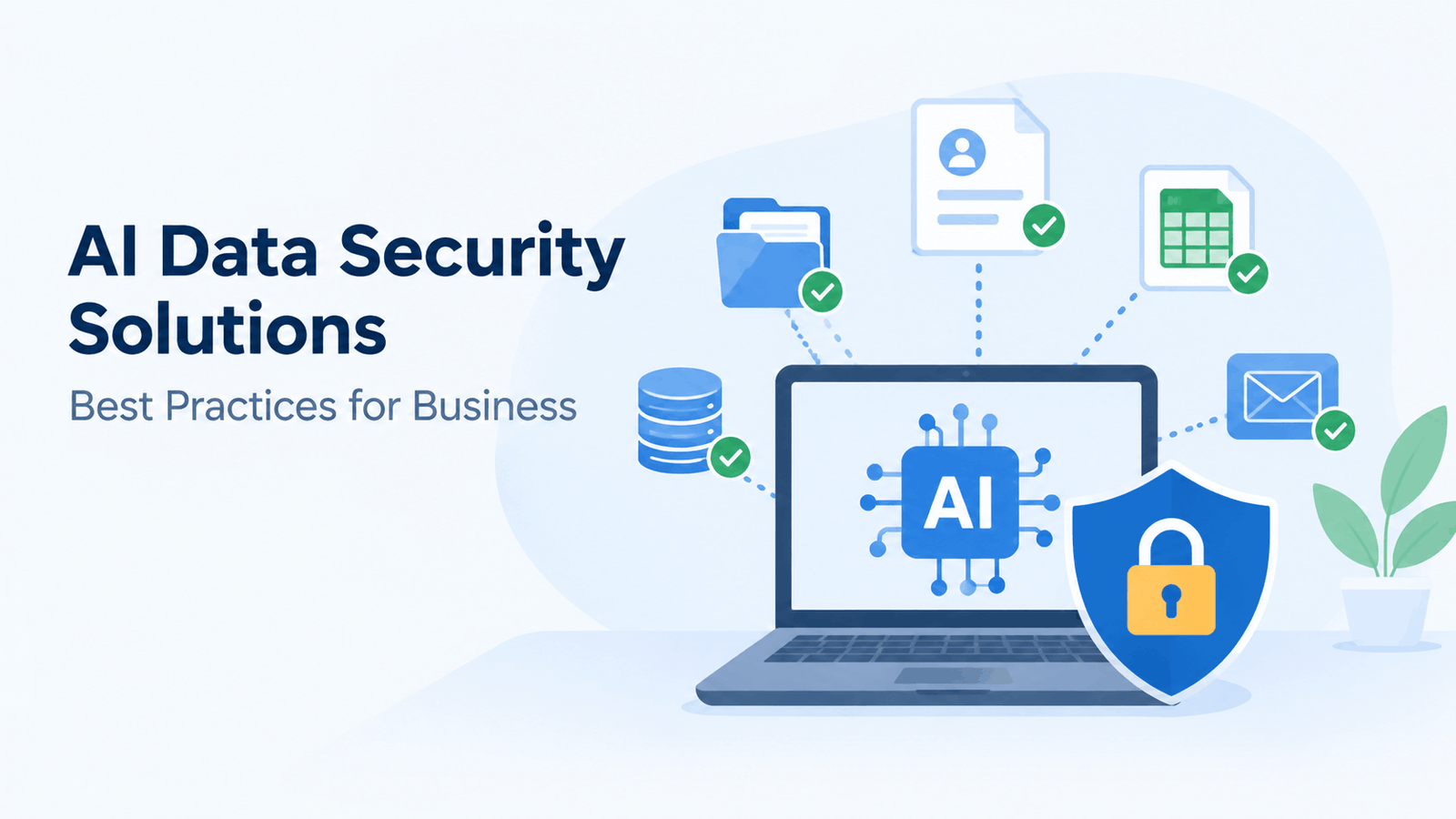
AI Data Security Solutions Best Practices for Business
AI adoption often starts with a simple decision.
Someone in the business finds an AI tool that can summarize documents, analyze spreadsheets, write reports, answer questions, or automate repetitive work. Within weeks, several teams may be using different AI applications.
The security problem usually appears later.
A security team may know which applications are officially approved, but that does not necessarily tell them what employees are actually putting into those applications. A confidential proposal, customer file, source code, financial report, or internal strategy document can become part of an AI workflow without anyone deliberately trying to bypass security.
That is why I believe businesses should look at AI data security differently from traditional application security.
The important question is not simply “Is our AI secure?”
It is “What business data can AI see, how is that data being used, and what controls exist when something goes wrong?”
Start With the Data, Not the AI Tool
One of the mistakes I see businesses make is starting with the AI platform.
They compare vendors, security certifications, privacy statements, and features before understanding what information employees are likely to give the system.
I would reverse that process.
Start by identifying your sensitive information.
Which documents contain customer information? Where are financial records stored? Which SharePoint sites contain intellectual property? Which files should never leave the company’s controlled environment?
Once those questions are answered, it becomes much easier to decide what AI applications should have access to that information.
This is where a proper data security strategy becomes important. Your existing data security approach should provide the foundation rather than creating a completely separate security model for AI.
The AI Data Problem Is Often an Employee Workflow Problem
Consider a common situation.
An employee receives a 30 page customer document and needs a quick summary. They copy the contents into an AI tool and get the answer in seconds.
From the employee’s perspective, this is productivity.
From the security team’s perspective, several questions immediately appear.
Was the document confidential?
Was the AI application approved?
Was customer information included?
Where was the information processed?
Was the data retained?
Can the employee retrieve or delete it later?
This is why an AI policy that simply says “Do not enter confidential information into public AI tools” is rarely enough.
Employees need practical guidance that matches how they actually work.
Use Data Classification to Make AI Controls Practical
You cannot protect sensitive information effectively if you do not know what is sensitive.
This is where data classification becomes more valuable than simply blocking AI applications.
A business could, for example, treat publicly available marketing information differently from customer records, financial information, intellectual property, or regulated information.
That allows security policies to become more precise.
Microsoft environments can use Microsoft Purview Information Protection as part of this approach. Classification and sensitivity labels can help organizations understand the importance of information and apply appropriate protection policies.
The objective should be simple: let employees use AI for appropriate work while making sensitive information harder to expose accidentally.
Look for AI Access Paths You Did Not Plan
AI does not only access information through an obvious chatbot.
It can become connected to email, document repositories, collaboration platforms, business applications, automation workflows, and internal systems.
That creates an important security question:
If an employee can access a piece of information, can an AI system acting on that employee’s behalf access it too?
This is where identity and permissions become critical.
An employee who has excessive access to company information creates risk even before AI is introduced. AI can simply make that existing access more powerful and easier to use.
Reviewing identity and access management therefore needs to be part of an AI security program.
Least privilege, strong authentication, access reviews, and conditional access policies can reduce the amount of information available to compromised or misused accounts.
Do Not Treat Data Loss Prevention as an AI Afterthought
Another practical area is data loss prevention.
If an organization already uses Microsoft 365, security teams should examine how existing DLP policies interact with the organization’s AI workflows.
For example, a company may already have rules designed to identify financial information, personal information, or confidential documents. Those controls become even more valuable when employees start using AI to process business information.
Microsoft Purview Data Loss Prevention can form part of this broader control layer.
The important point is not to create hundreds of complicated rules.
Start with a small number of high value scenarios.
Ask what information would cause the greatest business impact if it were exposed, then build controls around those scenarios first.
Monitor What People Actually Do
Policies tell employees what they should do.
Monitoring tells you what is actually happening.
This distinction matters.
You may discover that an application officially approved by the business is rarely used, while another AI tool is being used heavily by sales, finance, engineering, or HR teams.
That information can change your security priorities.
Look for unusual data movement, access to sensitive repositories, unexpected application usage, and activity involving highly confidential information.
This is also where cloud security, identity monitoring, data loss prevention, and security operations need to work together rather than operating as isolated controls.
Build AI Governance Around Real Business Decisions
AI governance becomes useful when it helps people make decisions.
Instead of creating a policy several pages long that employees will never read, define clear categories.
Which AI applications are approved?
What information can employees provide to them?
Which information requires additional approval?
Who owns an AI application?
How should an employee report suspected data exposure?
What happens when a new AI feature is introduced into an existing business application?
These decisions should be documented and reviewed as AI adoption changes.
A broader AI security governance program can connect these decisions with privacy, compliance, data protection, and security requirements.
A Better Way to Assess AI Data Risk
If I were reviewing an organization’s AI environment, I would not begin by asking how many AI security products it has purchased.
I would start with 5 questions:
What sensitive data is being used with AI?
Which AI applications can access it?
Which identities are allowed to access that data?
What happens if an employee makes a mistake?
Can the security team detect that mistake quickly?
If the answers are unclear, adding another security product may not solve the underlying problem.
A focused security assessment can help identify gaps across identity, data protection, cloud configuration, access permissions, and security monitoring before organizations invest in additional controls.
The Goal Is Safer AI Adoption, Not Less AI
Businesses should not have to choose between productivity and security.
The better approach is to make secure AI usage easier than insecure AI usage.
Give employees approved tools. Protect sensitive information through classification and DLP. Reduce unnecessary permissions. Monitor meaningful activity. Establish clear governance. Then review the environment regularly as new AI capabilities appear.
The strongest AI data security solutions are therefore not necessarily the ones with the longest feature list.
They are the ones that fit into the way your people already work and provide enough visibility and control to protect business information without becoming a barrier to AI adoption.
AI will continue to become part of everyday business operations. The organizations that handle it well will not be the ones that try to stop every new AI capability.
They will be the ones that understand where their data is going, why it is going there, and what controls are available when something goes wrong.
