
A Practical Framework for Evaluating Cloud Security Risks
Cloud misconfiguration now accounts for fourteen percent of all confirmed data breaches globally, up from roughly nine percent just two years ago, according to the 2026 Verizon Data Breach Investigations Report. The Cloud Security Alliance ranks misconfiguration as the number one threat to cloud computing, and IBM’s 2025 Cost of a Data Breach Report puts the average breach at $4.44 million worldwide — climbing past $10 million for U.S. companies specifically. None of this is caused by exotic zero-days. It’s caused by settings nobody reviewed.
This is a practical framework for evaluating cloud security risks — in plain terms, how to conduct a cloud security assessment that actually produces decisions instead of a report that sits unread in a shared drive. The sequence matters as much as the content: skip early steps and every stage after them inherits the gap.
What Is a Cloud Security Assessment?
A cloud security assessment is a structured evaluation of a cloud environment’s configuration, identity controls, data protection, and compliance posture, designed to surface risks before an attacker does. Unlike a traditional IT audit, it has to account for the shared responsibility model — the provider secures the underlying infrastructure, but configuration, access, and data controls are the customer’s job, every time.
Google Cloud’s CISO Perspectives research found seventy percent of cloud breaches now originate from compromised identities rather than exploited software vulnerabilities, and Palo Alto’s Unit 42 team, analyzing 680,000 real cloud identities, found ninety nine percent of users, roles, and service accounts held excessive permissions. A credible assessment has to weight identity as heavily as configuration — most don’t.
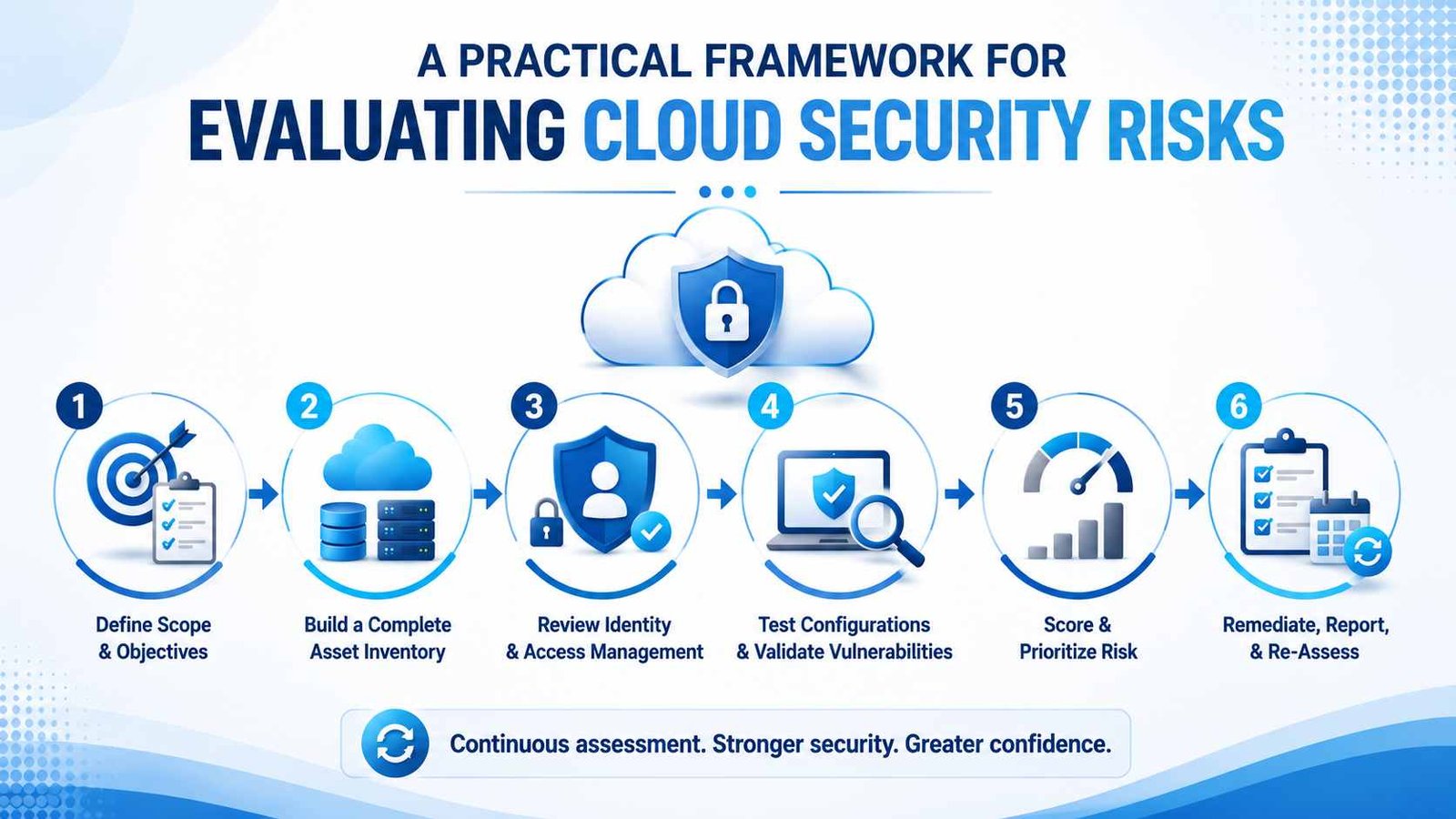
How to Conduct a Cloud Security Assessment: The Six-Step Framework
Trusted frameworks converge on a similar sequence, regardless of which vendor or standards body publishes them. Here is how to conduct a cloud security assessment that follows that sequence end to end.
Step 1: Define Scope and Objectives
Before reviewing anything, define what’s in scope — which accounts, subscriptions, regions, and data classifications — and why this cycle exists. A vague scope produces noisy findings and a team with a long issue list and no sense of what actually matters. Decide up front whether the assessment aligns to a specific framework, a compliance requirement, or both.
Step 2: Build a Complete Asset Inventory
You can’t secure what you don’t know you have. Inventory every account, subscription, storage bucket, compute instance, container, and SaaS integration connected to the environment. An incomplete inventory guarantees an incomplete risk picture — every later step in the assessment inherits this gap.
Step 3: Review Identity and Access Management
Given that seventy percent of cloud breaches trace back to compromised identities, this step deserves more time than most teams give it. Audit role-based access controls, confirm multi-factor authentication is enforced — especially for administrative accounts — and specifically hunt for stale permissions left over from completed projects, since those are exactly what attackers exploit months later.
Step 4: Test Configurations and Validate Vulnerabilities
Run vulnerability scans and configuration reviews across storage, networking, and workloads. Check encryption at rest and in transit, review firewall and network segmentation rules, and validate findings with real testing rather than relying solely on automated scanner output, which frequently overstates or misses context-dependent risk.
Step 5: Score and Prioritize Risk
Build a risk matrix that scores findings by severity and actual exploitability and blast radius — not by raw alert volume. A critical misconfiguration on an internet-facing production database matters more than a hundred low-severity findings on an isolated test environment, and your prioritization should say so explicitly.
Step 6: Remediate, Report, and Re-Assess
Document every gap, assign an owner, and set a remediation timeline tied to severity. Prepare a high-level summary for leadership alongside the technical findings, since a report only executives can’t parse doesn’t drive budget or action. Then schedule the next cycle — a cloud security assessment that runs once and never repeats is already stale the day after it’s delivered.
Not Sure Where Your Cloud Environment Actually Stands?
NG Cloud Security runs structured cloud security assessments across AWS, Azure, and GCP — scoping, identity review, configuration testing, and a prioritized remediation roadmap your team can actually act on
Choosing the Right Framework: CSA, NIST, or CIS
Framework selection should follow your environment, not auditor preference. Each of the three major frameworks does a different job well, and most mature programs end up using all three together rather than picking just one.
CSA Cloud Controls Matrix
Provides a broad cloud governance structure spanning identity, data security, and operations. Useful as an overall map, though a small team can struggle to operate every control without tailoring it to their actual environment. The full matrix is published by the Cloud Security Alliance.
NIST Cybersecurity Framework
Effective for communicating risk outcomes to leadership and boards, since it organizes findings into functions executives already understand — identify, protect, detect, respond, recover. It doesn’t provide the cloud-specific technical depth engineering teams often need on its own.
CIS Benchmarks
More prescriptive for service-level hardening — specific, checkable configuration settings for AWS, Azure, and GCP services. A practical stack pairs CIS for configuration detail, CSA for governance structure, and NIST CSF for executive reporting, with regulatory overlays layered in for evidence mapping where compliance requires it.
Tools That Support a Cloud Security Assessment
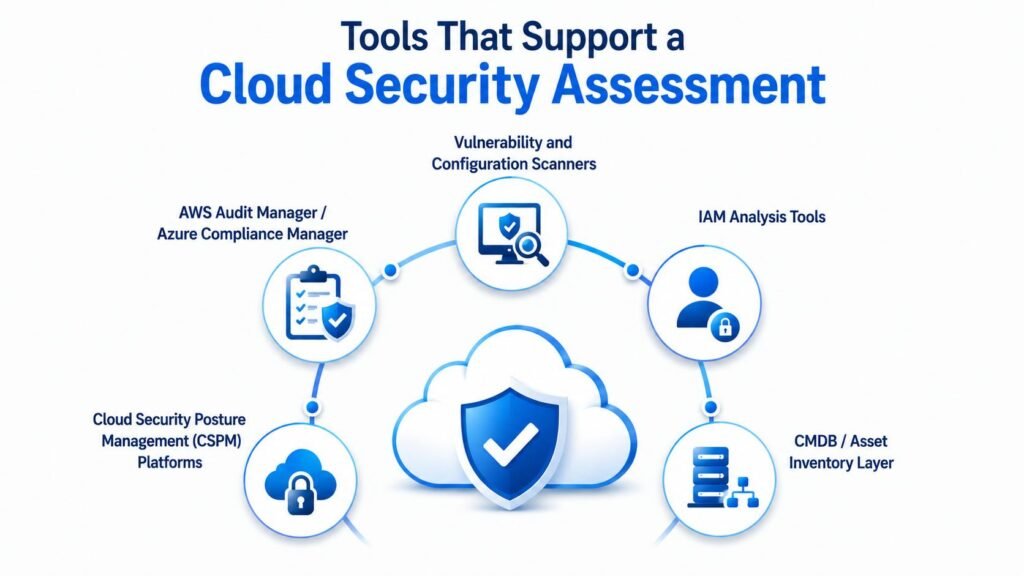
None of these tools replace the framework — they just make each step of how you conduct a cloud security assessment faster and more repeatable.
- Cloud Security Posture Management (CSPM) platforms: Continuously scan for misconfigurations across multi-cloud environments rather than relying on a single point-in-time snapshot.
- AWS Audit Manager / Azure Compliance Manager: Map current configuration against regulatory frameworks and generate audit-ready evidence automatically.
- Vulnerability and configuration scanners (Qualys, Tenable, and similar): Feed workload and network findings directly into the risk matrix rather than sitting in a separate, disconnected report.
- IAM analysis tools: Surface excessive permissions and stale access — the single largest identity risk category, per Unit 42’s research.
- A CMDB or asset inventory layer: Acts as the join point connecting CSPM, scanner, and compliance findings back to a single source of truth for every cloud resource.
Common Mistakes When Conducting a Cloud Security Assessment
These are the mistakes that most often derail an otherwise well-intentioned attempt at how to conduct a cloud security assessment properly.
- Starting with tooling before scope — running scanners across an environment nobody has actually mapped
- Treating configuration and identity as separate problems, when identity now drives the majority of cloud breaches
- Prioritizing findings by alert count instead of exploitability and blast radius
- Picking one framework and forcing every finding into it, instead of using CSA, NIST, and CIS together for what each does best
- Treating the assessment as a one-time compliance exercise rather than a recurring cycle
- Delivering a technical findings dump with no executive summary leadership can actually act on
How Often Should You Run a Cloud Security Assessment?
- At minimum annually, covering the full six-step framework across every in-scope environment.
- Quarterly for identity and access management specifically, since permissions and roles drift fastest between full assessments.
- Immediately after major changes — new cloud accounts, a merger or acquisition, a significant architecture change, or a confirmed security incident.
- Continuously where CSPM tooling allows it, since point-in-time assessments alone can’t keep pace with environments that change daily.
How NG Cloud Security Helps You Evaluate Cloud Security Risks
Most internal IT teams know a cloud security assessment matters but don’t have the bandwidth to run the full six-step framework properly alongside daily operations. If you’re still figuring out how to conduct a cloud security assessment internally, NG Cloud Security handles the entire cycle — scoping, asset discovery, IAM review, configuration testing, risk scoring, and a remediation roadmap sequenced by actual business impact, not alert volume.
Benefits of a Practical Cloud Security Risk Framework
- Converts scattered scanner output into a prioritized, actionable risk matrix
- Directly addresses identity risk, the root cause behind roughly seventy percent of cloud breaches
- Reduces exposure to the misconfiguration risk now behind fourteen percent of all confirmed breaches
- Gives leadership a report they can actually use to justify budget and prioritization
- Builds a repeatable cycle instead of a one-time snapshot that goes stale within weeks
Frequently Asked Questions
How do you conduct a cloud security assessment?
Follow a six-step framework: define scope and objectives, build a complete asset inventory, review identity and access management, test configurations and validate vulnerabilities, score and prioritize risk by exploitability and blast radius, then remediate, report, and schedule the next cycle. Skipping the early steps — especially scope and inventory — undermines everything that follows.
What framework should I use for a cloud security assessment?
Most mature programs use three frameworks together rather than picking one: CIS Benchmarks for specific, checkable service-level configuration, the CSA Cloud Controls Matrix for overall cloud governance structure, and the NIST Cybersecurity Framework for communicating risk outcomes to executives and boards in language they already understand.
How long does a cloud security assessment take?
A focused assessment of a single cloud environment can be completed in one to three weeks. Multi-cloud or enterprise-scale environments with extensive compliance requirements typically take four to eight weeks, particularly where asset inventory has not been well maintained beforehand.
What’s the biggest risk a cloud security assessment usually finds?
Identity-related issues, not configuration alone. Google Cloud’s CISO Perspectives research found seventy percent of cloud breaches originate from compromised identities, and Palo Alto’s Unit 42 team found ninety nine percent of analyzed cloud identities held excessive permissions. Most assessments that focus only on configuration miss the larger risk sitting in access control.
How often should a cloud security assessment be repeated?
At minimum annually for a full assessment, with identity and access management reviewed quarterly since permissions drift fastest. Organizations using continuous CSPM tooling can maintain near-real-time visibility between formal assessment cycles, which matters given how quickly modern cloud environments change.
Final Thoughts
A cloud security assessment is not a compliance checkbox — it’s how you stay honest about where your environment is actually exposed. The fourteen percent of breaches now tied to misconfiguration, and the seventy percent tied to compromised identity, are not abstract statistics. They are the direct, measurable cost of skipping this process or running it once and calling it done.
Follow the sequence, weight identity as heavily as configuration, and treat the assessment as a recurring cycle instead of a one-time report. Knowing how to conduct a cloud security assessment properly is the difference between a framework that produces real decisions and one that produces a document nobody reads again.
Ready to Find Out Where Your Cloud Risk Actually Sits?
Talk to NG Cloud Security about running a structured cloud security assessment across your environment scoped to your business, not a generic checklist.
