

Stateful vs Stateless Firewall: Key Differences Explained
Firewall is one of the most important parts of network security. But many people still do not fully understand the difference between stateful vs stateless firewalls. In my experience, organizations often focus on security tools but do not focus on how traffic is inspected. This is where understanding firewall types becomes very important for network protection and performance.
If you are building a secure network architecture or planning a cloud security strategy, understanding how firewalls work is very important. You can also learn more about overall cybersecurity strategy in this guide on cybersecurity services and solutions.
What Is a Stateless Firewall
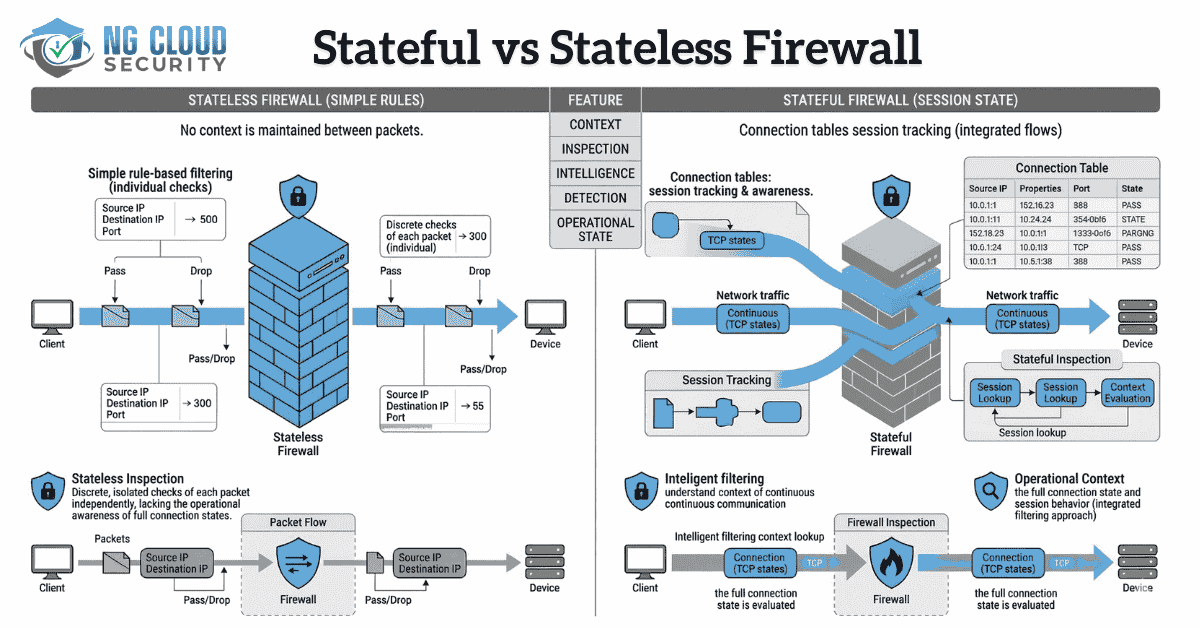
A stateless firewall checks each packet individually based on predefined rules. It does not remember previous packets or connection history. It only checks source IP address, destination IP address, port number, and protocol.
Stateless firewalls work using Access Control Lists. The administrator creates rules and the firewall allows or blocks traffic based on those rules. Every packet is treated as a new packet, and the firewall does not know whether the packet belongs to an existing session or not.
Stateless firewalls are commonly used in routers and basic filtering systems where speed is more important than deep inspection. Many organizations use stateless filtering as the first layer of security before traffic reaches advanced security systems like Azure Firewall solutions.
Advantages of Stateless Firewall
- The stateless firewall is very fast because it does not track sessions.
- It uses fewer system resources.
- It performs well in high traffic networks.
- It is cost effective and easy to configure.
Disadvantages of Stateless Firewall
- It provides less security because it does not track connection state.
- It cannot detect session based attacks.
- Manual configuration is required for return traffic.
- It cannot log detailed session activity.
What Is a Stateful Firewall
A stateful firewall is an advanced firewall that tracks the state of network connections. It monitors the full communication session and stores connection information in a state table. This table contains source IP, destination IP, ports, and session state.
Stateful firewall understands whether a packet is part of an existing session or a new connection request. This makes it more secure than a stateless firewall and very useful in modern cloud security environments where traffic behavior must be monitored.
How Stateful Firewall Works
A stateful firewall uses a state table to track active connections. When a user starts a connection, the firewall records the connection in the state table. Only packets that match the existing session are allowed.
The stateful firewall also understands the TCP connection process. For example, TCP connection uses SYN, SYN ACK, and ACK process to establish connection. The firewall tracks this process and allows only valid connections. When the session ends, the firewall removes the session from the state table.
Because of this behavior tracking, stateful firewalls can detect suspicious traffic patterns and unauthorized access attempts. This is why they are commonly used in enterprise networks and environments that follow Zero Trust security architecture.
Advantages of Stateful Firewall
- A stateful firewall provides higher security.
- It tracks active sessions and connection behavior.
- It can detect suspicious traffic and unauthorized access.
- It provides logging and monitoring features.
- It automatically allows return traffic for valid sessions.
Disadvantages of Stateful Firewall
- It uses more memory and CPU resources.
- It is slower than a stateless firewall.
- It costs more than a stateless firewall.
- It can be affected by DDoS attacks if too many sessions are created.
Key Difference Between Stateful vs Stateless Firewall
| Feature | Stateful Firewall | Stateless Firewall |
| Packet Inspection | Full session inspection | Header inspection only |
| Connection Tracking | Yes | No |
| Security | High | Medium |
| Performance | Slower | Faster |
| Memory Usage | High | Low |
| Logging | Yes | Limited |
| Best For | Enterprise networks | Small networks |
Stateful vs Stateless Firewall Based on Business Needs
For small businesses, a stateless firewall can be a good option because it is affordable and easy to manage. Small networks usually have limited traffic and fewer cyber threats.
For large organizations and enterprise environments, a stateful firewall is a better choice because it provides better protection, session tracking, and attack detection. It is especially important when organizations are using cloud services, remote access, and identity based security systems like Identity and Access Management solutions.
In modern cybersecurity, many organizations use both firewalls together. Stateless firewall works as a first filtering layer, and stateful firewall performs deep inspection. This layered security approach improves both performance and security and also supports endpoint security protection strategies.
When To Choose Stateful vs Stateless Firewall
You should choose a stateful firewall if your organization handles sensitive data, financial transactions, customer information, or cloud applications.
You should choose a stateless firewall if you need fast traffic filtering, low cost security, or basic network protection.
Most modern organizations use a layered security model where stateless firewall filters basic traffic and stateful firewall inspects and monitors active sessions.
Conclusion
Stateful vs stateless firewall is a common comparison in network security. A stateless firewall is fast and simple but provides limited security because it does not track connection state. Stateful firewall tracks sessions, understands traffic behavior, and provides better protection against cyber attacks.
In my experience, the best approach is to use both firewalls together as part of a layered security strategy. This approach improves network security, visibility, and performance. Choosing the right firewall depends on your business goals, security requirements, and network architecture.
