

What Is A Zero Day Attack Examples Every It Team Should Know
Cyber threats continue to evolve, and some of the most damaging incidents happen before organizations even realize a weakness exists. One of the most important topics every security professional should understand is what is a zero day attack. For IT teams managing enterprise applications, cloud environments, and remote users, this threat is highly relevant because it can bypass traditional security controls and create serious business disruption.
In my experience, many organizations focus only on known vulnerabilities and patch cycles. The challenge with zero day threats is that attackers often move before vendors release a fix. That makes preparation, visibility, and layered security far more important than relying only on updates.
What Is a Zero Day Attack
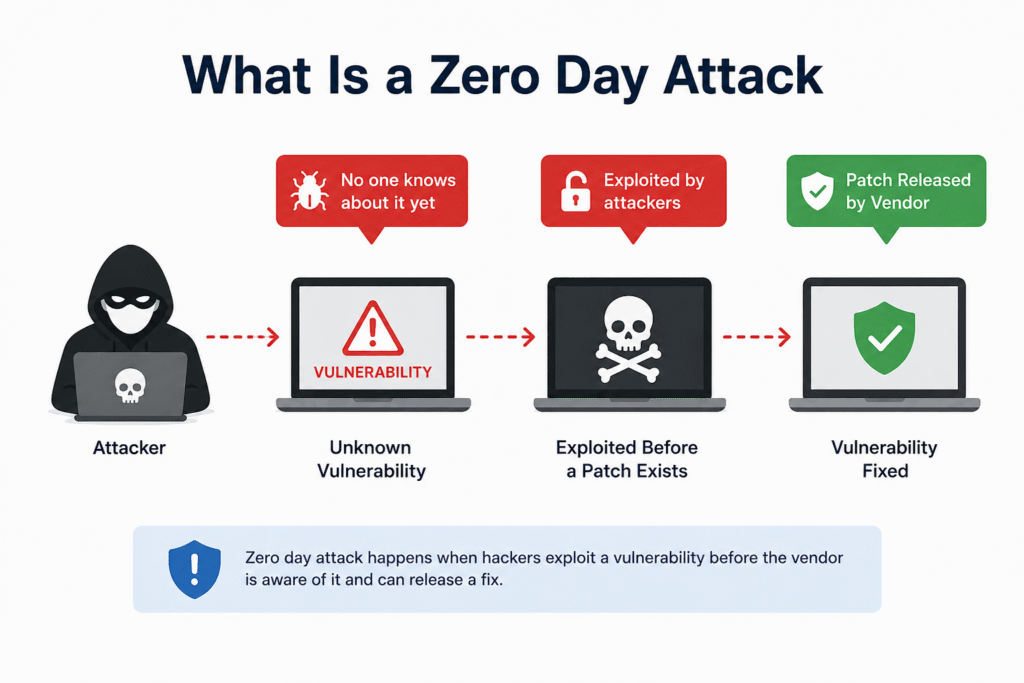
A zero day attack is a cyberattack that exploits a software vulnerability before the software vendor releases a patch. The term zero day means the vendor has had zero days to fix the flaw once attackers begin using it.
A zero day issue usually starts with a hidden software weakness that has not yet been identified by the developer. Once threat actors discover that flaw, they create an exploit and launch attacks against vulnerable systems.
To understand the topic properly, there are three related concepts.
Zero day vulnerability
This is the unknown flaw in software, firmware, operating systems, or hardware.
Zero day exploit
This is the code or technique used by attackers to take advantage of the flaw.
Zero day attack
This is the actual cyber incident when the exploit is used to compromise systems, steal information, or deploy malware.
How a Zero Day Attack Works
A zero day attack usually follows a predictable lifecycle.
Vulnerability is introduced
A software vendor releases a product containing a hidden security flaw.
Attackers discover the weakness
Threat actors identify the flaw before the vendor notices it.
Exploit is created
The attacker develops malicious code to take advantage of the weakness.
Attack begins
The exploit is delivered through phishing emails, malicious websites, or compromised applications.
Patch is released
Once the vendor becomes aware, a security patch is developed.
Patch deployment
Organizations install the update, reducing exposure.
The risk remains high if businesses delay patching internet facing systems.
Why Zero Day Attacks Are Dangerous
Zero day attacks are difficult because they often evade signature based tools. Traditional antivirus solutions detect known threats, but zero day exploits are new and can slip past those controls.
The biggest concerns include:
No immediate fix
Security teams may not have a patch available.
Silent compromise
Attackers can stay hidden for weeks.
High value targeting
Email systems, browsers, identity platforms, and cloud workloads are common targets.
Rapid spread
A single widely used software flaw can impact thousands of organizations.
This is why many businesses combine vulnerability management with advanced monitoring through managed detection platforms.
Real Zero Day Attack Examples
Stuxnet
Stuxnet is one of the most well known examples of a zero day attack. It exploited multiple Windows vulnerabilities to compromise industrial control systems and disrupt physical equipment.
Log4Shell
Log4Shell affected the Apache Log4j library used in many Java applications. Because the library was embedded in countless systems, the attack surface became global.
Microsoft Exchange attacks
Attackers exploited several zero day vulnerabilities in Microsoft Exchange servers to gain access to corporate email systems and sensitive communications.
Google Chrome zero day attacks
Modern browsers are frequent targets because they are used daily by employees. Several Chrome vulnerabilities have been exploited to deploy spyware and remote access malware.
Common Targets of Zero Day Vulnerabilities
Zero day vulnerabilities can affect nearly any digital environment.
Web browsers
Chrome, Edge, Safari, and Firefox.
Enterprise applications
Email platforms, collaboration tools, and ERP systems.
Cloud services
Management consoles, APIs, and identity services.
Security tools
VPN gateways, firewalls, and endpoint security platforms.
This makes zero day preparedness essential for organizations adopting cloud security strategies.
How IT Teams Can Reduce Zero Day Risk
Use behavior based detection
Tools like EDR and XDR can detect suspicious behavior instead of only known malware signatures.
Apply Zero Trust security
A Zero Trust model reduces lateral movement after initial compromise. A Zero Trust model reduces lateral movement after initial compromise. You can see this in Zero Trust Network Access vs VPN Which Is More Secure in 2026 and What Are the Three Principles of Zero Trust Architecture Explained.
Strengthen endpoint monitoring
Endpoint visibility helps detect unusual activity early. Related reading includes Top Endpoint Security Threats and Difference Between EDR and Antivirus Which Offers Better Protection.
Improve cloud security posture
Cloud workloads should be monitored for misconfigurations and exposed services. For broader strategy, refer to Cloud Security Challenges and Best Practices for Cloud Security Protect Your Data.
Conduct security assessments
Regular reviews identify weak points before attackers do. A proactive approach often starts with Cloud Security Assessment and Security Assessment Control.
Final Thoughts
If you are searching for what is a zero day attack, the simplest explanation is that it is an attack that exploits a hidden software flaw before defenders can patch it.
What makes these threats serious is not only the technical sophistication but also the timing. Attackers act while organizations are still unaware. That is why strong visibility, endpoint monitoring, identity protection, and Zero Trust controls are essential for modern IT environments.
Businesses that combine proactive monitoring, patch discipline, and continuous assessments are better positioned to reduce the impact of zero day threats.
