
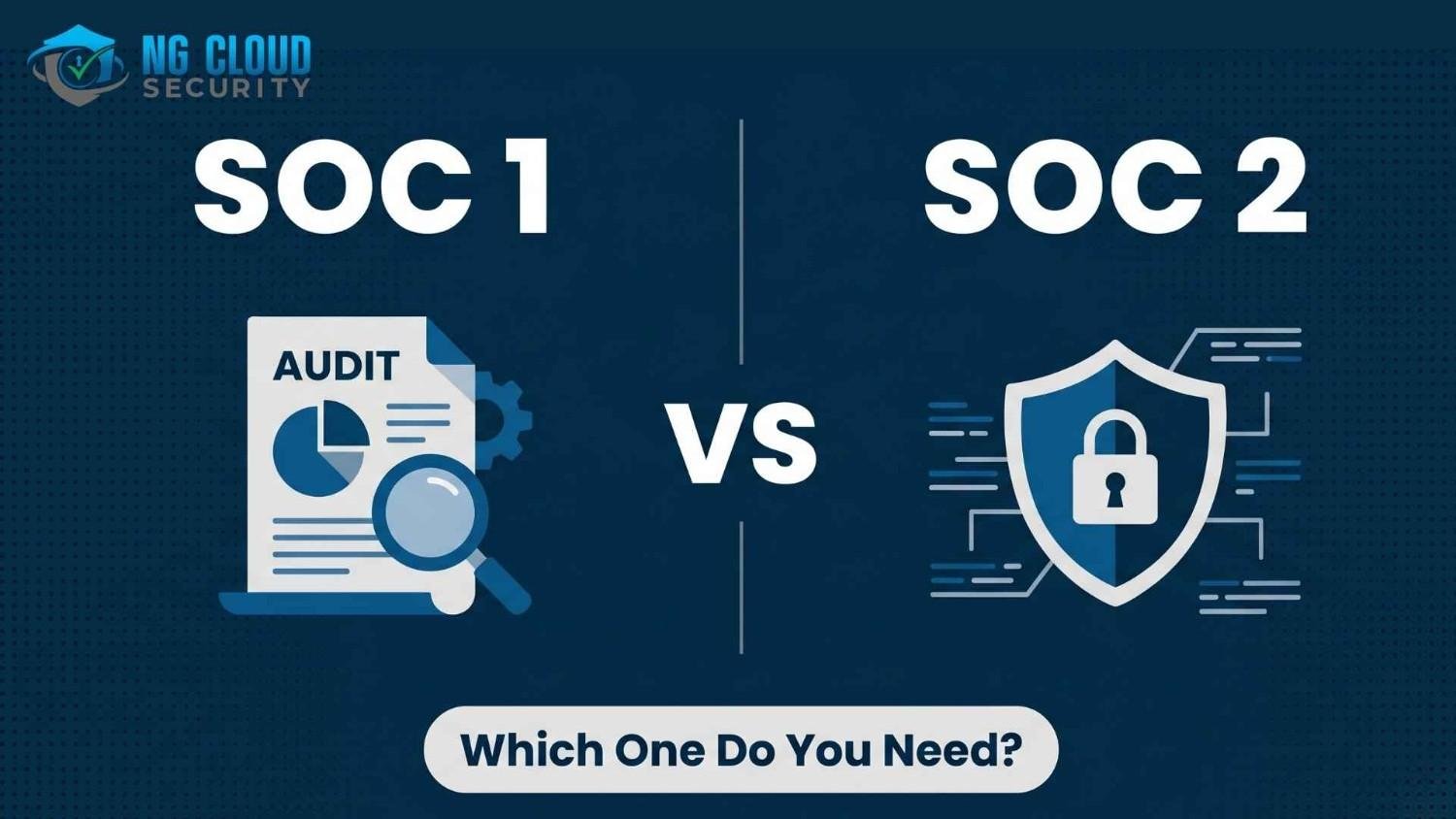
SOC 1 vs SOC 2 Difference: Which One Do You Need?
When businesses start focusing on compliance and data security, one common confusion I often see is around SOC 1 vs SOC 2 difference. Both reports are important, both are issued by auditors, and both build trust. But they serve very different purposes.
From my experience working with growing companies and enterprises, choosing the right SOC report depends entirely on your business model, your clients, and the type of data you handle. If you are already investing in security assessment and compliance services, understanding this difference becomes even more important.
Let me break it down in a simple and practical way.
What is SOC 1?
SOC 1 focuses on financial reporting controls. It is designed for service organizations that directly impact their client’s financial statements.
For example, if you are handling payroll processing, financial transactions, or billing systems, your services influence financial data. In such cases, SOC 1 becomes relevant.
SOC 1 answers one key question.
Are your internal controls reliable enough to ensure accurate financial reporting?
This report is mainly useful for auditors, finance teams, and stakeholders who care about financial integrity.
What is SOC 2?
SOC 2 is more about data security and operational controls. It evaluates how well your systems protect customer data based on five trust principles.
These include security, availability, processing integrity, confidentiality, and privacy.
If your business stores or processes customer data, especially in the cloud, SOC 2 is usually expected. Many organizations that invest in cloud security solutions or data security strategies align closely with SOC 2 requirements.
SOC 2 answers a different question
Are you handling customer data in a secure and trustworthy way?
This is why SaaS companies, cloud providers, and managed service providers often go for SOC 2.
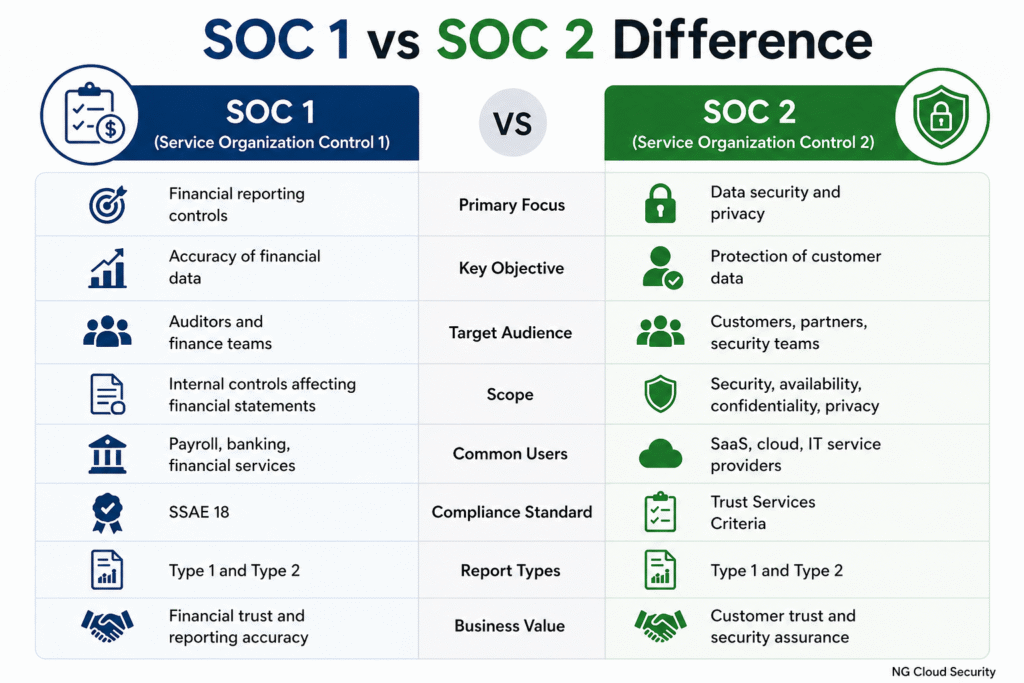
SOC 1 vs SOC 2 Difference Table
To make things even clearer, here is a side by side comparison based on real world use cases.
| Aspect | SOC 1 | SOC 2 |
| Primary Focus | Financial reporting controls | Data security and privacy |
| Key Objective | Accuracy of financial data | Protection of customer data |
| Target Audience | Auditors and finance teams | Customers, partners, security teams |
| Scope | Internal controls affecting financial statements | Security, availability, confidentiality, privacy |
| Common Users | Payroll, banking, financial services | SaaS, cloud, IT service providers |
| Compliance Standard | SSAE 18 | Trust Services Criteria |
| Business Value | Financial trust and reporting accuracy | Customer trust and security assurance |
| Report Types | Type 1 and Type 2 | Type 1 and Type 2 |
Key SOC 1 vs SOC 2 Difference
Understanding the core difference helps you avoid unnecessary compliance costs and effort.
Purpose
- SOC 1 is about financial controls.
- SOC 2 is about data protection and system security.
Target Audience
- SOC 1 is mainly for auditors and financial stakeholders.
- SOC 2 is for customers, partners, and security teams.
Scope
- SOC 1 covers controls related to financial reporting.
- SOC 2 covers security, availability, confidentiality, and privacy.
Industry Relevance
- SOC 1 is common in finance related services.
- SOC 2 is widely used in technology, SaaS, and cloud environments.
Business Impact
- SOC 1 builds trust in financial accuracy.
- SOC 2 builds trust in data security and operational reliability.
Types of SOC Reports
Both SOC 1 and SOC 2 have two types of reports.
Type 1 evaluates controls at a specific point in time.
Type 2 evaluates how effectively those controls operate over a period.
In real business scenarios, most clients prefer Type 2 because it shows consistency and maturity. This is also where partnering with managed SOC services can help maintain continuous monitoring and audit readiness.
Which One Do You Need?
This is where many businesses make mistakes. They choose based on trends instead of actual need.
Here is a practical way to decide.
Choose SOC 1 if
- Your services impact financial transactions or reporting.
- You work with accounting systems or payroll platforms.
- Your clients require assurance on financial controls.
Choose SOC 2 if
- You store or process customer data.
- You provide cloud based or SaaS services.
- Your clients ask about security and data protection.
In many cases, I have seen companies needing both. For example, a fintech platform may require SOC 1 for financial accuracy and SOC 2 for data security. Implementing a Zero Trust security approach further strengthens SOC 2 readiness.
Why SOC 2 is More Popular Today
With the rise of cloud computing and digital transformation, SOC 2 has become more relevant.
Clients today are more concerned about data breaches, privacy risks, and system availability. A SOC 2 report directly addresses these concerns.
In my experience, companies that invest in SOC 2 early gain a competitive advantage. It not only improves security posture but also speeds up sales cycles since clients feel more confident. Many businesses combine this with cloud security assessment to identify gaps before audits.
Common Mistakes to Avoid
Many businesses either overinvest or underprepare when it comes to SOC compliance.
One common mistake is choosing SOC 1 when SOC 2 is actually required. This happens when companies misunderstand client expectations.
Another mistake is treating SOC compliance as a one time task. In reality, it is an ongoing process that involves monitoring, documentation, and continuous improvement.
Also, ignoring internal readiness can delay the audit. Proper policies, access controls, and monitoring systems should be in place before starting. Leveraging IT consulting and advisory services can make this process smoother.
Final Thoughts
Understanding the SOC 1 vs SOC 2 difference is not just about compliance. It is about aligning your business with the right standards that build trust and support growth.
If your focus is financial accuracy, SOC 1 is the right path.
If your focus is customer data protection and system security, SOC 2 is essential.
In many modern businesses, especially in cloud and SaaS environments, SOC 2 has become almost a standard expectation.
From my experience, the right approach is to evaluate your services, understand client requirements, and then choose the report that truly reflects your risk and responsibility.
Making the right decision here can strengthen your credibility, improve client confidence, and open doors to bigger opportunities.
Need help with SOC compliance?
Learn cybersecurity compliance best practices here
