
How Does Zero Trust Work? A Simple Breakdown for Business Owners
One of the most common questions I hear from business owners today is simple but important. How does zero trust work and why is it becoming the foundation of modern cybersecurity. From my experience working with organizations moving to cloud and hybrid environments, traditional security models no longer match how businesses actually operate. Users work remotely, applications live across multiple clouds, and data moves constantly. This is where zero trust security changes the way protection works. Instead of trusting everything inside a network, zero trust verifies every request every time.
What Zero Trust Means in Real Life
Zero trust is built on one core idea. Trust nothing by default and verify everything continuously. It is formally defined in the Zero Trust Architecture published by NIST, which explains why trust should never be assumed and must always be verified. Older security models focused on protecting the network perimeter. Once users were inside, they were trusted. That approach no longer works when cloud applications, remote users, and third party access are part of daily operations. This is why many organizations now adopt cybersecurity and zero trust security as a long term strategy rather than a single tool.
How Does Zero Trust Work Step by Step
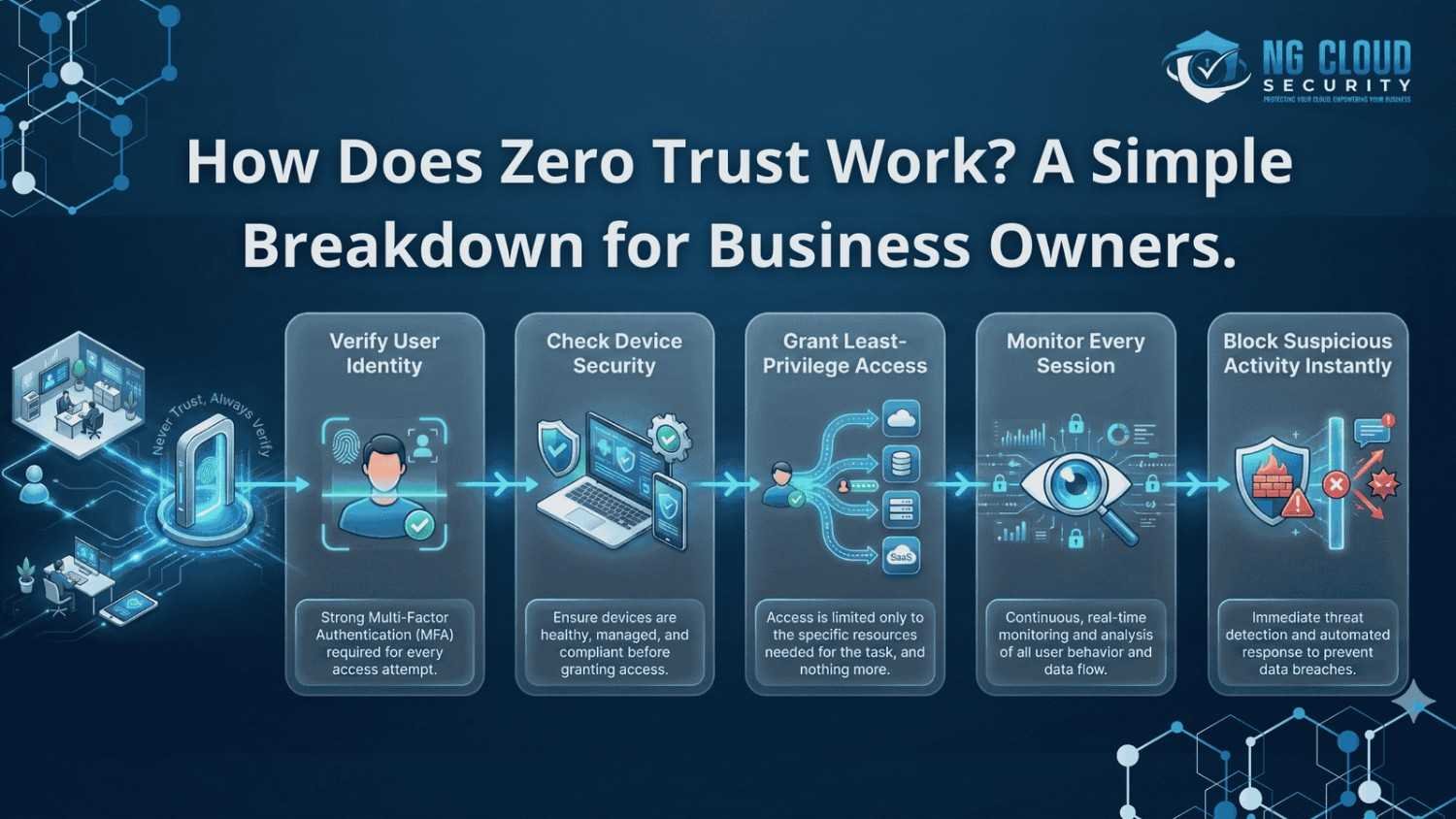
To truly understand how does zero trust work, it helps to see what happens when a user tries to access a system. When access is requested, the system evaluates multiple factors such as identity, device security posture, location, and behavior. Only after verification is access granted, and even then it is limited to what is required. This approach aligns closely with modern modern identity and access management IAM practices that focus on secure access rather than network location.
Identity Becomes the New Control Point
In a zero trust model, identity replaces the traditional network perimeter. Every user must authenticate using strong identity controls, often supported by conditional access and continuous verification. In my experience, identity based security significantly reduces the impact of stolen credentials. Organizations that invest in Microsoft Entra Suite and identity assessments often gain better visibility and control over who can access what and under which conditions.
Devices Are Verified Before Access
Zero trust does not stop with user identity. It also checks the security health of the device being used. Before granting access, the system verifies whether the device meets security requirements such as updates, encryption, and endpoint protection status. If the device does not comply, access is restricted. This is where endpoint security and endpoint security assessment play a critical role in enforcing trust at the device level.
Least Privilege Access Reduces Risk
Another important principle behind how does zero trust work is least privilege access. Users are only given access to the resources they need for their role. Nothing more. Nothing permanent. For example, access to sensitive data can be limited and monitored through data security and Microsoft Purview data loss prevention controls, ensuring information is not misused even after access is granted.
Continuous Monitoring Instead of One Time Checks
Zero trust is not a one time login check. It continuously evaluates user activity throughout the session. If risk increases due to unusual behavior, access can be re evaluated instantly. This might mean requiring additional verification or blocking access altogether.
This level of monitoring is often supported by tools like Microsoft Sentinel and SOC managed services, which provide real time visibility and response capabilities.
Protecting Applications and Cloud Workloads
Zero trust applies across cloud and hybrid environments, not just internal systems. Whether applications run in Microsoft 365, Azure, or multi cloud platforms, access is governed by the same verification principles. This is especially important for businesses using cloud security and cloud infrastructure solutions to scale operations securely.
Why Zero Trust Matters for Business Owners
From a business perspective, understanding how does zero trust work helps leaders make smarter security investments. Zero trust reduces breach impact, supports secure remote work, improves compliance readiness, and aligns security with real business workflows. It also integrates naturally with managed IT and security operations, making security easier to manage over time.
Final Thoughts
Zero trust is not about adding complexity. It is about removing assumptions. In my experience, businesses that adopt zero trust gain stronger security, better control, and more confidence in their digital growth. By verifying identity, validating devices, limiting access, and monitoring continuously, zero trust creates a security model that actually fits how modern businesses work today.
